Openlane
Getting SOC 2 or ISO 27001 certified means proving, with evidence, that your policies match reality — normally a spreadsheet nightmare or a $10k-a-year SaaS subscription (Vanta, Drata). Openlane does the same evidence-collection and tracking job as open-s
🔗 Visit Openlane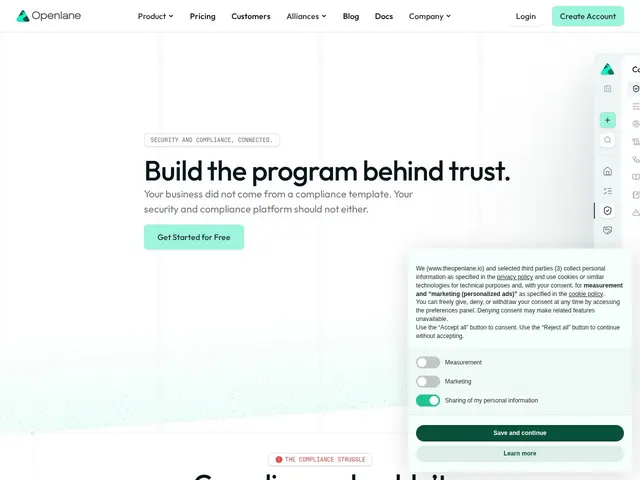
Description
Compliance certifications like SOC 2 exist to prove to customers that you actually do what your security policy says you do — access is restricted, backups run, incidents get logged. Proving it usually means someone manually screenshotting settings pages every quarter, or paying a company like Vanta a recurring fee to automate the screenshotting for you. Openlane offers a third path: the same automated evidence-collection idea, but as open-source software, so a startup that can't justify Vanta's price tag isn't stuck doing it by hand either.
Openlane is an Apache 2.0-licensed, Go-based compliance automation platform supporting 12+ frameworks (SOC 2, ISO 27001, GDPR, HIPAA, PCI-DSS, NIST 800-53, ISO 42001, and more). It provides policy and procedure management, a risk and vulnerability register, automated evidence collection via integrations with AWS, Azure, GCP, GitHub, Google Workspace, Slack, Tailscale, and Entra ID, plus a public-facing Trust Center portal and role-based workflow approvals. It's available self-hosted (free) or as a managed cloud service with usage-based pricing.
💬 Our review
The short version: Openlane is a real, credible open-source alternative to paying Vanta or Drata for compliance automation — worth serious evaluation for a startup on a budget, though it's a much younger, smaller-community project than the incumbents it's positioned against.
The framework coverage (12+, spanning SOC 2 through ISO 42001 for AI governance) and the integration list are genuinely comparable to what the paid platforms offer, and being open source means you can inspect exactly how evidence is collected and stored — relevant when the product's whole job is proving trustworthiness. Self-hosting it also sidesteps a legitimate objection some security teams have to Vanta/Drata: handing a third-party SaaS platform deep read access into your AWS/GCP/GitHub accounts.
The honest limits: at under 300 GitHub stars, this doesn't have Vanta or Drata's years of auditor relationships, integration polish, or dedicated customer success teams walking you through your first audit — those incumbents sell the hand-holding as much as the automation. Self-hosting also means you own the uptime and maintenance of a system your auditors will be looking at. For an engineering-heavy team comfortable running its own infrastructure and wanting to avoid recurring SaaS fees, Openlane is a legitimate pick; for a first-time SOC 2 process where you want a vendor holding your hand through the audit, the established paid platforms remain the lower-friction choice.
💰 Pricing
📊 Global score
🤖 AI-enriched data
Cœur open source (licence Apache 2.0) gratuit et auto-hébergeable ; offre cloud managée avec tarification à l'usage (non détaillée publiquement).
Pros
Open source (Apache 2.0), auto-hébergeable gratuitement — alternative crédible aux plateformes payantes
Couvre 12+ référentiels (SOC 2, ISO 27001, GDPR, HIPAA, PCI-DSS, NIST 800-53, ISO 42001...)
Intégrations natives AWS, Azure, GCP, GitHub, Google Workspace, Slack, Entra ID
Transparence totale sur la collecte de preuves — inspectable, contrairement à une boîte noire SaaS
Cons
Communauté et écosystème bien plus petits que Vanta/Drata (moins de 300 étoiles GitHub)
Pas d'accompagnement audit/relation auditeur dédié comme chez les plateformes payantes établies
Auto-hébergement = responsabilité de la fiabilité d'un système que vos auditeurs vont examiner