IncidentRelay
A free, self-hosted answer to "who's on call tonight and how do we wake them up if something breaks" — schedules, escalations, and alert routing that you run on your own servers instead of paying a per-seat SaaS like PagerDuty.
🔗 Visit IncidentRelay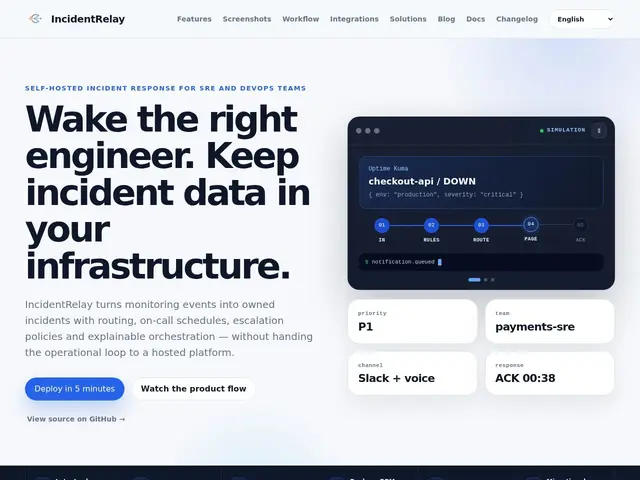
Description
Every team running production software eventually needs an answer to 'it's 3am, something's on fire, who gets paged and what happens if they don't respond in 5 minutes.' PagerDuty built a whole business answering that question — for a per-seat monthly fee that adds up fast as a team grows. IncidentRelay answers the same question as free, self-hosted software: you own the on-call schedule, the escalation logic, and the alert data instead of renting it.
IncidentRelay is an open-source (MIT) on-call scheduling, alert routing, and incident response platform. It ingests alerts from Prometheus Alertmanager, AWS SNS/CloudWatch, Grafana Alerting, Zabbix, Sentry, Datadog, LibreNMS, Uptime Kuma, and generic webhooks, then routes them by source, label, or severity, and escalates through configurable chains to Slack, Telegram, Mattermost, Discord, email, or voice. It handles rotations with overrides, maintenance windows, alert fatigue controls, and heartbeat monitoring, includes a Terraform provider for infrastructure-as-code setup, and ships with migration tooling to import existing PagerDuty or Grafana OnCall configurations. It deploys via Docker, Kubernetes/Helm, RPM, or systemd.
💬 Our review
The short version: IncidentRelay covers the same core job as PagerDuty — schedules, escalation, alert routing — for free, and the fact that it ships migration tools from PagerDuty and Grafana OnCall specifically signals it's aimed at teams actively trying to leave those platforms.
The integration list is the strongest argument here: Prometheus Alertmanager, Grafana Alerting, Sentry, Datadog, and more are covered out of the box, so it's not a toy that only works with one monitoring stack. The Terraform provider is a nice touch for teams that already manage everything else as code, and voice escalation plus alert fatigue controls are table-stakes features that a lot of self-hosted alternatives skip.
The honest limits: at 181 GitHub stars, this is a small, young project relative to Grafana OnCall (which has a much larger community and Grafana's backing) — for something that pages humans at 3am, project maturity matters more than most categories. There's no managed/hosted option, so you're responsible for the reliability of the very system meant to tell you when your other systems are unreliable — a real chicken-and-egg risk worth thinking through (host it somewhere separate from what it's monitoring). For a small team comfortable self-hosting and wanting to cut a PagerDuty bill, it's worth a pilot; for anything where paging reliability is mission-critical, weigh that against Grafana OnCall's larger track record or simply keeping PagerDuty.
💰 Pricing
📊 Global score
🤖 AI-enriched data
Open source (licence MIT), gratuit, auto-hébergé (Docker, Kubernetes/Helm, RPM, systemd).
Pros
Gratuit et open source (MIT), auto-hébergé — pas de coût par utilisateur
Larges intégrations : Prometheus Alertmanager, Grafana Alerting, Sentry, Datadog, Zabbix, AWS SNS/CloudWatch...
Outils de migration inclus depuis PagerDuty et Grafana OnCall
Provider Terraform pour une configuration en tant que code
Cons
Projet jeune et modeste (181 étoiles GitHub) comparé à Grafana OnCall ou PagerDuty
Pas d'offre hébergée/managée — la fiabilité du système d'astreinte dépend entièrement de votre auto-hébergement
À héberger séparément de l'infrastructure qu'il surveille pour éviter le risque de panne en cascade