Pygmy
A free, open-source, self-hosted URL shortener with built-in analytics — customizable short links, auto-expiry, and geo-location click tracking, without sending your link data through a third-party shortening service.
🔗 Visit Pygmy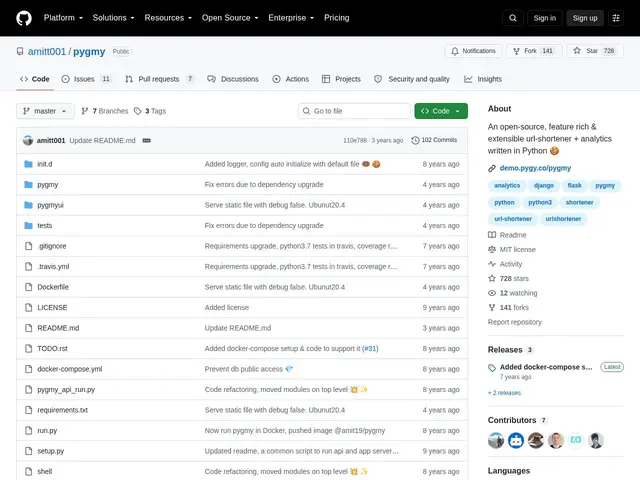
Description
Public URL shorteners are convenient, but every link you create tells a third-party service where your traffic is going and who's clicking it — data you might prefer to keep for yourself. Pygmy is a self-hosted alternative: a small app you run on your own server that shortens links and tracks clicks, more like keeping your own mailroom instead of routing every letter through a courier that reads the address labels.
Pygmy is a free, open-source (MIT) URL shortener built in Python with a Flask-based REST API and a Django UI layer, supporting PostgreSQL, MySQL, or SQLite as the backend. It lets you create customizable short codes, set auto-expiring links, protect links with a secret key, and track clicks through a user dashboard with analytics and geo-location tracking derived from visitor IPs. Its loosely coupled architecture is meant to make custom integrations straightforward for developers who want to extend it.
💬 Our review
The short version: if you want basic link shortening with click analytics on infrastructure you control, Pygmy is a free, no-frills option — though it's a smaller, older project than the current leaders in this space.
Compared to more actively promoted 2026 self-hosted shorteners, Pygmy's advantage is simplicity and a stable, small codebase (roughly 100 commits, MIT license) rather than a large feature set — it does short links, expiry, and analytics, and not much beyond that. Against a public shortener like Bitly, the tradeoff is the usual one for self-hosting: you keep click and referrer data private on your own server instead of handing it to a company whose business model may involve using that data.
The honest limits: at under 1,000 GitHub stars with roughly a decade of history, it's a modest, slower-moving project rather than one under active heavy development, so don't expect frequent new features or a large plugin ecosystem. Geo-location tracking relies on IP-based lookups, which are approximate rather than precise. For someone who wants a lightweight, private, self-hosted shortener with basic analytics and nothing more, it's a reasonable free pick; for a actively-developed tool with a larger community and richer analytics dashboards, it's worth comparing against newer self-hosted alternatives before committing.
💰 Pricing
📊 Global score
🤖 AI-enriched data
Open source (licence MIT), gratuit et auto-hébergé.
Pros
Auto-hébergé — données de clics et de trafic restent privées, contrairement à un service public
Liens personnalisables avec expiration automatique et protection par clé secrète
Tableau de bord avec analytics et géolocalisation des clics
Architecture légère, plusieurs bases de données supportées (PostgreSQL, MySQL, SQLite)
Cons
Projet modeste (moins de 1000 étoiles GitHub) et développement plus lent que les alternatives récentes
Géolocalisation basée sur l'IP — approximative, pas précise
Écosystème de fonctionnalités plus restreint que les raccourcisseurs auto-hébergés plus actifs