ExpenseOwl
A free, open-source, self-hosted expense tracker that turns your spending into simple monthly pie charts — no budgeting complexity, no cloud account, just quick entry and a clear picture of where your money goes.
🔗 Visit ExpenseOwl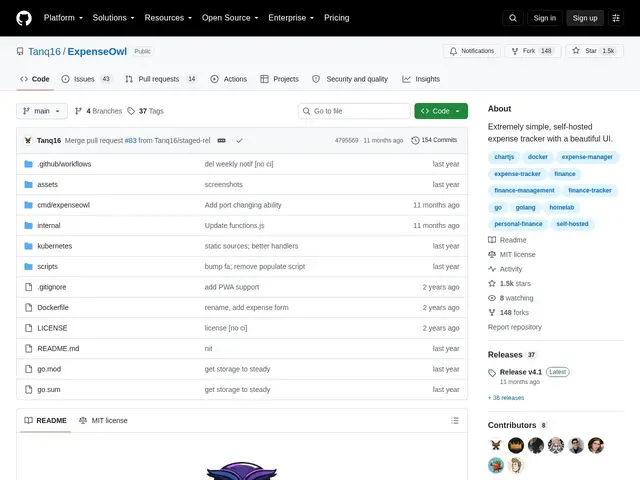
Description
Most budgeting apps pile on features — bank syncing, envelope budgeting, investment tracking — until logging a quick coffee purchase feels like homework. ExpenseOwl strips all that away: it's a tiny self-hosted app that does exactly one thing, tracking what you spend and showing it back to you as a simple monthly pie chart, closer to a paper notebook you glance at than a full accounting system.
ExpenseOwl is a free, open-source (MIT) expense tracker written in Go, deployable as a lightweight Docker container with either a JSON file or PostgreSQL as the backend. It supports quick expense and income entry, recurring transactions, custom categories and currency symbols, tags, light/dark themes, CSV import/export, and works as an installable PWA. It's built for self-hosters who want a fast answer to 'where did my money go this month' without connecting a bank account or handing spending data to a third-party finance app.
💬 Our review
The short version: if budgeting apps feel like overkill and you just want a private, self-hosted way to see your monthly spending as a clear pie chart, ExpenseOwl does exactly that and nothing more — for free.
Compared to a full personal finance tool like YNAB or Actual Budget, which model envelope budgeting, goals and bank syncing, ExpenseOwl deliberately does none of that: no budgets, no bank connections, no forecasting — just fast entry and a visual breakdown of where money went. That's a real limitation if you want to plan ahead, but a real advantage if you've been put off by how much setup those tools demand.
The honest limits: with no bank syncing, every transaction is manual entry, which won't scale for someone tracking dozens of transactions a day across multiple accounts. It's also a young, small project (1,500 GitHub stars) built around one focused use case — homelab-style personal tracking — so don't expect multi-user households or business expense features. For a single person who wants a five-minute, self-hosted, judgment-free way to see monthly spending patterns, it's a great free fit; for real budgeting, forecasting, or bank-synced finance, a dedicated tool like Actual Budget is the better choice.
💰 Pricing
📊 Global score
🤖 AI-enriched data
Open source (licence MIT), gratuit et auto-hébergé (Docker).
Pros
Installation ultra-simple en Docker, backend JSON ou PostgreSQL au choix
Visualisation en camembert mensuel, claire et immédiate
Transactions récurrentes, catégories et devises personnalisables
Import/export CSV, thème clair/sombre, installable en PWA
Cons
Aucune synchronisation bancaire — toute saisie est manuelle
Pas de budgétisation par enveloppes ni de prévisions, contrairement à Actual Budget/YNAB
Projet jeune et de niche (1500 étoiles GitHub), pensé pour un usage individuel