NoteDiscovery
A free, open-source, self-hosted note-taking app that keeps everything as plain Markdown files on your own server — with a graph view, drawing tool, and math support, plus a built-in bridge for AI assistants like Claude to read and organize your notes dir
🔗 Visit NoteDiscovery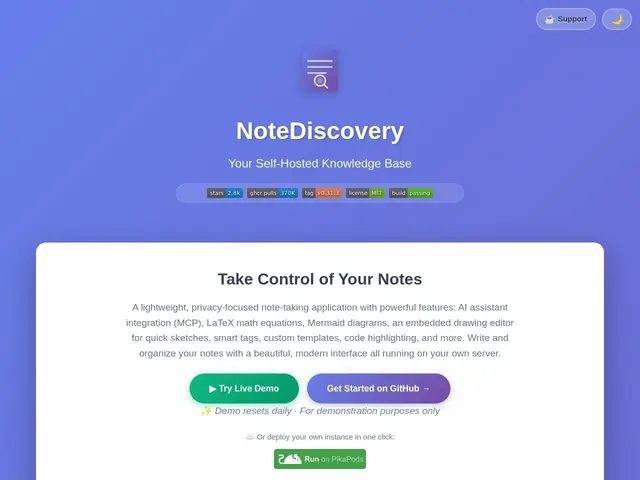
Description
Notion and other cloud note apps are convenient, but your notes end up locked inside someone else's database, reachable only through their app. NoteDiscovery works the opposite way: it stores every note as a plain Markdown file on a server you control, a bit like keeping your notes in labeled folders you own outright instead of renting a locker at someone else's storage facility — you can back it up with a simple copy command, or move it anywhere, any time.
NoteDiscovery is a free, open-source (MIT) self-hosted knowledge base built around a folder of Markdown files, with no proprietary database format. It includes an interactive graph view for visualizing links between notes, a built-in drawing editor, LaTeX/MathJax support for equations, full-text search that works offline (including on air-gapped networks), multiple themes, and HTML export. Its standout 2026 feature is a built-in MCP (Model Context Protocol) server, so AI assistants like Claude Desktop and Cursor can search, create and organize notes directly, without manual copy-pasting.
💬 Our review
The short version: if you want a Notion-like note-taking experience without giving up your data, and you'd like Claude or Cursor to be able to read and organize your notes directly, NoteDiscovery is a genuinely well-timed free alternative.
Compared to Obsidian, the most popular self-hosted-adjacent note app, NoteDiscovery's core advantage is native MCP support out of the box — Obsidian needs a community plugin to get similar AI integration, while NoteDiscovery ships it as a first-class feature. Against Notion, the tradeoff is the usual one for self-hosted tools: less real-time collaboration polish, but your notes live as plain files on your own server instead of inside a vendor's proprietary database.
The honest limits: at roughly 2,800 GitHub stars, it's a smaller, younger project than Obsidian or Notion, so expect a narrower plugin ecosystem and fewer third-party integrations. Real-time multi-user collaboration also isn't its focus — it's built around one person's (or one server's) vault, not a shared team workspace. For an individual or small team that wants full data ownership, Markdown-native notes, and AI-assistant integration without extra plugins, it's a strong free pick; teams needing polished real-time co-editing should stick with Notion.
💰 Pricing
📊 Global score
🤖 AI-enriched data
Open source (licence MIT), gratuit et auto-hébergé.
Pros
Notes stockées en Markdown brut sur votre propre serveur — aucun format propriétaire
Serveur MCP intégré nativement pour Claude/Cursor, sans plugin tiers
Fonctionne hors-ligne, y compris sur réseau air-gapped
Vue graphe interactive, éditeur de dessin intégré, support LaTeX/MathJax
Cons
Projet plus jeune et plus petit (~2800 étoiles GitHub) qu'Obsidian ou Notion
Écosystème de plugins tiers plus restreint
Pas conçu pour la collaboration temps réel multi-utilisateurs