ThoughtDAG
A free, open-source infinite canvas that turns your conversations with AI models into an editable graph — so you can see, prune, and reuse exactly which parts of the conversation the AI is actually reading, instead of a single ever-growing chat thread.
🔗 Visit ThoughtDAG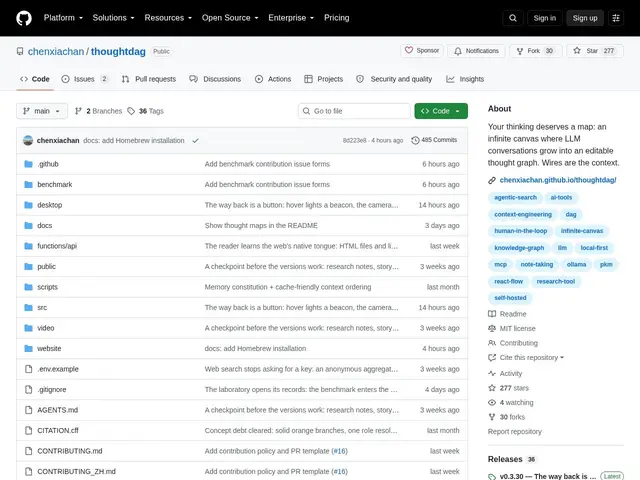
Description
Long chats with ChatGPT or Claude tend to turn into an unreadable scroll where old context quietly shapes new answers in ways you can no longer see or fix. ThoughtDAG treats a conversation less like a chat log and more like a mind map: every reply becomes a node on an infinite canvas, and the lines connecting them are the actual context the AI uses to answer — like sticky notes on a wall where you can literally see and rearrange which notes influence which new idea.
ThoughtDAG is an open-source (MIT) web app, built with React, TypeScript, React Flow and the Vercel AI SDK, that represents each LLM exchange as a node in a directed graph rather than a linear thread. When you ask a follow-up from any node, ThoughtDAG walks only the incoming edges connected to that node, orders the relevant ancestors, and sends just that subset as context to the model — so you can delete or rewire a connection to change what the AI 'remembers' without deleting the underlying message. It supports PDF ingestion for direct questioning, multi-tier zoom (from full detail down to icon-level overview), automatic local backup to a .thoughtdag.json file, Markdown export of any chain, read-only link sharing, and connects to a local Ollama instance or any OpenAI-compatible endpoint. There's also a hosted demo for trying it without installing anything.
💬 Our review
The short version: if long AI conversations regularly turn into a mess where you've lost track of what's influencing what, ThoughtDAG's graph-based context is a genuinely different and useful way to work — and it costs nothing since it's open source.
Most chat UIs — including ChatGPT and Claude's own interfaces — give you a single linear thread with no way to see or edit what's actually being sent as context on a long conversation; branching or 'regenerate' features are the closest equivalent, and they're much cruder. ThoughtDAG's edges-as-context model is closer to how tools like Obsidian's graph view work for notes, but applied directly to live LLM conversations, which is a fairly novel niche.
The honest limits: it's a young project (a few hundred GitHub stars, no dedicated funding model visible), so expect some rough edges and a learning curve — thinking in graphs instead of scrolling a chat is a different mental model, and it won't suit someone who just wants quick answers. It also doesn't support MCP, so it can't plug into your existing tool ecosystem the way some other AI interfaces can. For research, complex multi-topic investigations, or anyone who's felt an AI 'forget' something a chat thread buried twenty messages ago, it's worth trying since it's free and self-hostable; for casual day-to-day chat, a normal chat app remains simpler.
💰 Pricing
📊 Global score
🤖 AI-enriched data
Open source (licence MIT), gratuit en local ou auto-hébergé ; démo web gratuite disponible sans installation.
Pros
Contexte visible et éditable sous forme de graphe, au lieu d'un fil de discussion opaque
Gratuit et open source (MIT), auto-hébergeable ou utilisable via la démo web
Ingestion de PDF pour interroger directement des documents dans le graphe
Export Markdown et sauvegarde automatique locale en JSON
Cons
Projet jeune (quelques centaines d'étoiles GitHub), rugosités attendues
Pas de support MCP — ne s'intègre pas à l'écosystème d'outils existant
Courbe d'apprentissage : penser en graphe demande un changement d'habitude par rapport à un chat classique