ai-memory
A free, open-source tool that gives AI coding assistants a shared, persistent memory — so switching from Claude Code to Cursor to Codex doesn't mean re-explaining your whole project from scratch every time.
🔗 Visit ai-memory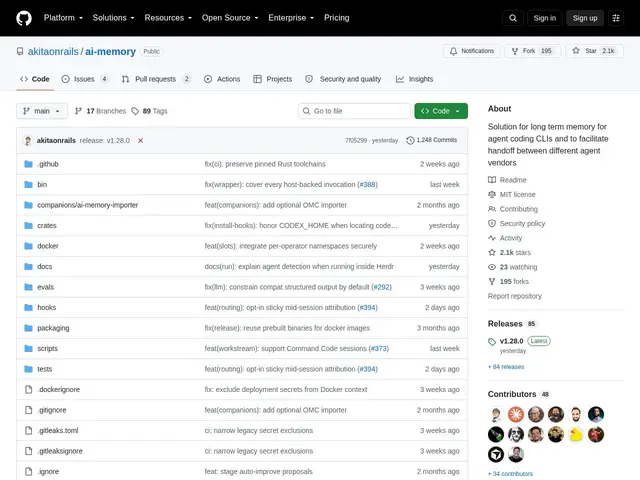
Description
If you use more than one AI coding assistant, you've probably hit the same annoyance: each one starts from zero, with no idea what you discussed with the other tool five minutes ago. ai-memory fixes that by giving your AI agents a shared notebook — a persistent, searchable record of decisions, context and progress that any of them can read from and write to.
ai-memory is an open-source (MIT) tool that automatically captures the context of your AI coding sessions — prompts, tool calls, decisions — into a git-versioned Markdown wiki with full-text search. It works across 15+ agent vendors (Claude Code, Codex, and others), so a handoff from one tool to another carries real project context instead of starting cold. It includes entity-based recall (optionally consolidated by an LLM), "workstreams" for tracking ongoing multi-session work, a web UI, multi-user attribution, and privacy controls (allowlist mode, per-repository exclusions) so you control exactly what gets captured. At 4,390 GitHub stars, it's a young but fast-growing project.
💬 Our review
The short version: if your team or workflow already spans multiple AI coding agents, ai-memory solves a real, specific pain point — context loss on every tool switch — that none of the individual agent vendors have strong incentive to fix themselves.
The key differentiator versus relying on each vendor's built-in memory (Cursor's or Codex's native context features) is that ai-memory is vendor-neutral by design: the whole point is that Claude Code, Codex and others can all read and write to the same shared record, so you're not locked into one tool's private memory silo. It's also fully self-hosted and git-versioned, meaning your project context lives in your own repo history, not on a vendor's server. Compared to just keeping your own notes or a scratch file, the automated, hook-based capture removes the discipline problem — it happens whether you remember to do it or not.
The honest limits: it requires initial hook setup, and how well it works still depends on each vendor's integration quality, which will vary. At 4,390 stars it's a young project (created mid-2026), so expect some rough edges and evolving conventions rather than a mature, battle-tested standard. For a developer or team juggling several AI coding tools, it's a genuinely useful piece of glue; for someone loyal to a single agent, the built-in memory of that tool is probably enough on its own.
💰 Pricing
📊 Global score
🤖 AI-enriched data
Outil open-source (MIT), entièrement gratuit et auto-hébergé.
Pros
Neutre vis-à-vis du vendeur — fonctionne avec 15+ agents IA (Claude Code, Codex...)
Capture automatique par hooks, sans discipline manuelle requise
Wiki Markdown versionné Git avec recherche plein texte
Gratuit, open-source (MIT), auto-hébergé, contrôles de confidentialité (allowlist)
Cons
Configuration initiale des hooks nécessaire
Qualité d'intégration variable selon le vendeur d'agent IA
Projet jeune (créé mi-2026) — conventions encore en évolution