AgentSight
A free tool that watches what your AI coding agent is actually doing at the operating-system level — no code changes, no SDK, works even with closed-source agent CLIs.
🔗 Visit AgentSight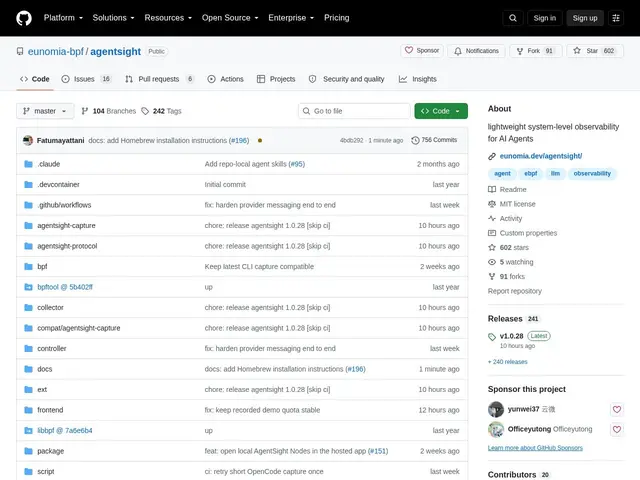
Description
Most tools that monitor AI agents require the agent to cooperate: you add an SDK, wrap API calls, or integrate a proxy. That doesn't work if the agent is a closed-source CLI like Claude Code or Gemini CLI, and it also means the agent's own instrumentation could be blind to something it wasn't told to report. AgentSight sidesteps this entirely by watching from outside the process, at the operating system level.
AgentSight uses eBPF — a Linux kernel technology for safe, low-overhead system observation — to intercept TLS-encrypted LLM traffic and correlate it with kernel-level events like file access and network activity, without requiring any SDK, proxy, or code changes to the agent itself. It works with Claude Code, Codex, Gemini CLI, OpenCode, OpenClaw, or effectively any command-line agent. It's built to detect prompt injection attacks, catch resource-wasting reasoning loops, and reveal coordination bottlenecks in multi-agent systems, all while adding under 3% performance overhead. It ships with a web dashboard showing session timelines, process trees, and a 'semantic flamegraph' for reasoning traces, is grounded in peer-reviewed research (published at a 2026 ML-for-systems workshop), and is free and open-source under MIT.
💬 Our review
The short version: AgentSight is a technically serious answer to a problem most 'AI agent observability' tools sidestep — actually seeing what an agent does at the system level, including agents you can't instrument because they're closed-source CLIs.
The eBPF approach is the real differentiator versus SDK-based competitors like LangSmith or Langfuse, which only see what the application chooses to report. Watching from the kernel means AgentSight can catch things the agent itself might not surface — a runaway reasoning loop burning tokens, or a coordination stall between multiple agents — and it can do this for a proprietary CLI tool with zero code changes. That's a meaningfully different capability class.
The honest gaps: eBPF is a Linux kernel feature, so this won't help on Windows or in restrictive sandboxed environments, and it requires enough systems comfort to set up kernel-level tracing correctly, which is a higher bar than installing an SDK. For teams running agents on Linux who want deep, agent-agnostic visibility, it's a genuinely novel tool; for a simpler, cross-platform LLM call tracer, an SDK-based tool like Langfuse remains easier to adopt.
💰 Pricing
📊 Global score
🤖 AI-enriched data
Entièrement gratuit et open-source (MIT).
Pros
Fonctionne sans SDK ni modification de code, même sur des CLI fermées
Observation au niveau kernel via eBPF, moins de 3% d'overhead
Détecte injections de prompt, boucles de raisonnement gaspilleuses, blocages multi-agents
Adossé à une publication de recherche évaluée par les pairs
Cons
eBPF = Linux uniquement, pas de support Windows
Setup plus technique qu'une intégration SDK classique
Communauté encore modeste comparée aux ténors du secteur (LangSmith, Langfuse)