Mole
A command-line research agent that answers questions with cited, fact-checked sources instead of confidently making things up, and stops before it burns through your API budget.
🔗 Visit Mole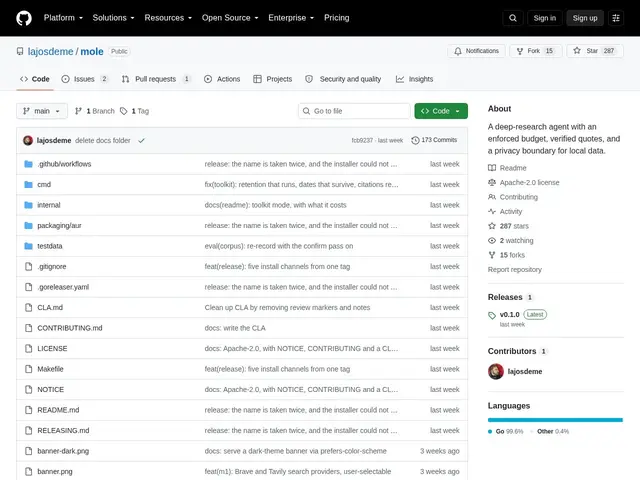
Description
Ask a typical AI chatbot to research something and it will happily give you a fluent, confident answer that might be partly fabricated — and keep calling APIs until you notice the bill. Mole is built to avoid both problems: every claim it makes is checked against the source it came from, and you set a hard budget it will not exceed.
Mole is an open-source research agent written in Go that decomposes a question into sub-questions, searches across the web plus academic sources like Crossref, OpenAlex, arXiv, and PubMed, extracts claims, and verifies each one against the text it was pulled from before writing a cited final answer. It enforces a dollar- or token-based budget with zero overshoot, can analyze local CSV/JSON data with a built-in privacy boundary so that data never leaves your machine, and speaks MCP so it can be driven by a coding agent like Claude Code. It runs as a single static binary using your own API keys (Tavily or Brave for search, Anthropic or any OpenAI-compatible/local model for reasoning), installable via script, Homebrew, AUR, or .deb/.rpm packages.
💬 Our review
The short version: Mole is a research tool built around a real, specific fear — AI research agents that hallucinate confidently and rack up API costs unpredictably — and it solves both with hard budget enforcement and per-claim source verification.
The claim-verification step is the standout: rather than trusting the model's synthesis, Mole checks each individual claim against the actual source text and flags contradictions, which is a meaningfully higher bar than most 'AI research assistant' tools that just cite sources without verifying the claims against them. The academic source coverage (Crossref, OpenAlex, arXiv, PubMed) also makes it more useful than general web-search agents for anything research-adjacent.
The honest gaps: it's a young project (290 stars, still under active early development) with no hosted version — you bring your own API keys and run it locally or via MCP, which is a real setup step for non-technical users. It's also CLI/MCP-first, so there's no polished web UI. For developers and researchers who want rigor and cost control over convenience, it's a genuinely useful tool; for a zero-setup answer engine, a hosted product like Perplexity is the easier choice.
💰 Pricing
📊 Global score
🤖 AI-enriched data
Open-source (Apache-2.0), gratuit ; vous utilisez vos propres clés API (Tavily/Brave pour la recherche, Anthropic ou modèle compatible OpenAI/local pour le raisonnement).
Pros
Vérification de chaque affirmation contre sa source réelle
Budget strict (dollars ou tokens) sans dépassement
Couverture de sources académiques (Crossref, OpenAlex, arXiv, PubMed)
Interface MCP pour être piloté par un agent codeur comme Claude Code
Cons
Projet jeune (290 étoiles), encore en développement actif
Pas de version hébergée — setup local avec vos propres clés API requis
Pas d'interface web soignée, orienté CLI/MCP