Exemplar
A control plane that governs what AI coding agents are allowed to do in your infrastructure — approvals, cost budgets, audit trail — combined with classic uptime monitoring and incident management.
🔗 Visit Exemplar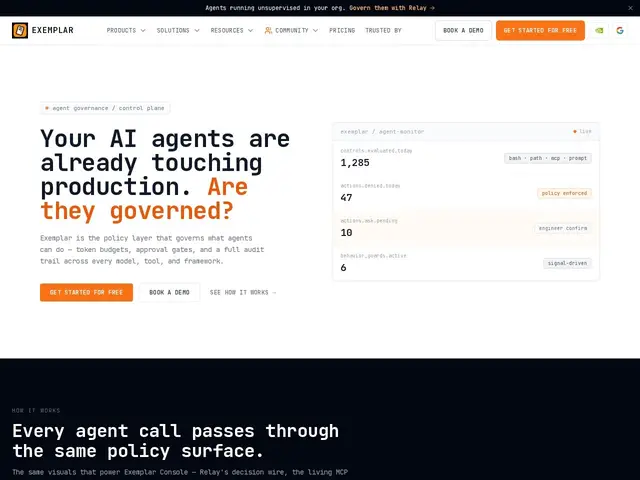
Description
AI coding agents like Cursor and Claude Code are increasingly given real access to production systems — they can run commands, call APIs, and touch infrastructure directly. That's powerful, but it also means a single bad instruction can do real damage with nobody in the loop to stop it. Exemplar sits between your AI agents and your systems as a checkpoint: every action gets cleared — allowed, flagged for approval, or denied — before it actually runs.
Under the hood it's four pieces working together: Marshal provides the building blocks (tools, prompts, skills, guardrails, human-in-the-loop checkpoints) for running agents safely in production; Relay enforces those policies directly inside Cursor and Claude Code; DevX Assist is a governed MCP layer for connecting agents to your dev tooling; and Guardrails handles tool access control and cost governance, with Exemplar citing a 61% reduction in token spend from smarter model routing. Alongside the agent-governance layer, it also covers traditional SRE ground — uptime monitoring, incident management, status pages, and self-service Day 2 operations automation — so it functions as a single control plane for both AI-agent safety and classic reliability engineering.
💬 Our review
The short version: if your engineering team has given AI coding agents real access to production and that keeps you up at night, Exemplar is one of the few products built specifically to put a governance layer in front of those agents — approvals, budgets, and an audit trail — rather than trusting the agent's own judgment.
Its closest comparison isn't really PagerDuty or Better Uptime (classic incident/status tools it also competes with on the SRE side) but the emerging category of AI-agent guardrail platforms — and there, Exemplar's advantage is combining agent governance with the operational tooling (uptime, incidents, status pages) that SRE teams already need, instead of forcing you to bolt a separate guardrail product onto your existing PagerDuty setup. The tradeoff is that dual positioning: teams evaluating it purely as an uptime/incident tool will find plenty of more mature, cheaper single-purpose competitors, and pricing isn't published, which makes it harder to compare on cost upfront. For a team specifically worried about ungoverned AI agents touching production, it's a genuinely novel fit; for a team that just wants a status page, it's overkill.
💰 Pricing
📊 Global score
🤖 AI-enriched data
Palier gratuit disponible ('Get started for free'), grille tarifaire complète sur devis/page dédiée non publique.
Pros
Gouverne les actions des agents IA avant exécution (allow/ask/deny)
Combine gouvernance d'agents IA et outillage SRE classique (uptime, incidents, status pages)
Réduction citée de 61% des dépenses de tokens via routage de modèles
50+ connecteurs, plusieurs frameworks IA supportés
Palier gratuit pour démarrer
Cons
Tarification non publique
Positionnement double (gouvernance agents + ops SRE) qui peut brouiller la proposition de valeur
Acteur récent face à des outils SRE établis