jax-js
A JavaScript machine learning library that brings JAX's array and automatic-differentiation API to the browser, compiling to WebGPU for GPU acceleration.
🔗 Visit jax-js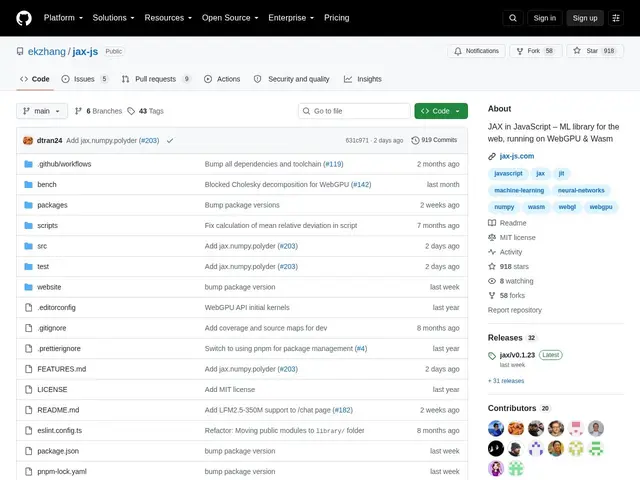
Description
Running machine learning code natively in a web browser usually means either shipping a Python backend or settling for TensorFlow.js's more limited API. jax-js brings the JAX programming model — the same array-and-autodiff style used by many serious ML research teams — directly into JavaScript, compiling your code down to run on the GPU via WebGPU.
It reimplements JAX/NumPy-style array operations and automatic differentiation in pure TypeScript with zero dependencies, compiling numerical code to WebGPU (and WebGL/WebAssembly as fallbacks) so it runs client-side with real GPU acceleration. It's installable via npm (@jax-js/jax), MIT-licensed, and actively developed — 918 GitHub stars, frequent commits, with an in-browser REPL for trying it without any setup.
💬 Our review
The short version: if you want to run real GPU-accelerated ML computation directly in a browser tab — inference, small training loops, interactive demos — without a Python backend, jax-js gives you a genuinely JAX-like API to do it, and it's free and open-source.
Compared to TensorFlow.js, the more established browser ML library, jax-js's differentiator is the JAX-style functional API (transformations, automatic differentiation) that ML researchers are already used to, plus a WebGPU-first backend for better GPU utilization than TF.js's older WebGL path. It's younger and less battle-tested than TensorFlow.js, with a smaller ecosystem of pretrained models and tutorials, so expect to write more of your own tooling around it. For anyone already comfortable with JAX on the server side wanting the same mental model in the browser, it's a strong fit; for production apps needing mature model zoos and broad browser support today, TensorFlow.js remains the safer default.
💰 Pricing
📊 Global score
🤖 AI-enriched data
100% gratuit, licence MIT. Package npm @jax-js/jax. Pas de version payante.
Pros
API façon JAX (transformations, différentiation automatique) familière aux chercheurs ML
Backend WebGPU avec repli WebGL/WebAssembly pour l'accélération GPU
Zéro dépendance, TypeScript pur
Projet actif (918 stars, commits fréquents)
REPL intégré pour tester sans installation
Cons
Écosystème plus jeune et restreint que TensorFlow.js
Peu de modèles pré-entraînés ou tutoriels par rapport aux frameworks établis
Cas d'usage de niche (ML dans le navigateur uniquement)
Contraintes de l'environnement navigateur vs ML côté serveur