Hillock
A lightweight, local-first memory engine for edge AI that combines hyperdimensional computing and associative memory instead of a vector database.
🔗 Visit Hillock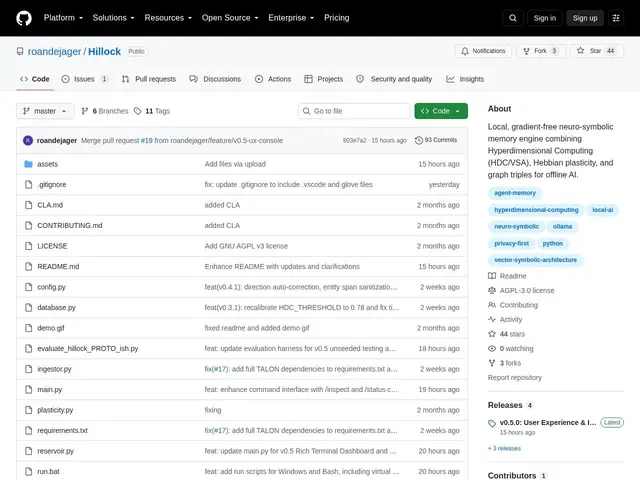
Description
Most local AI memory tools lean on vector databases and embeddings, which need real compute and can still return confidently wrong answers. Hillock takes a different approach: it's a lightweight memory engine that combines a few older, more deterministic AI techniques — hyperdimensional computing and Hebbian-style associative memory — to run on edge hardware with a tiny footprint, and it's built to say 'I don't know' rather than guess.
It runs entirely local, using SQLite-backed knowledge graphs, a coreference/relation-extraction pipeline (TALON), and a deterministic similarity gate that refuses to answer uncertain queries instead of hallucinating. Document ingestion runs in under 5 seconds with a sub-1.2GB VRAM footprint, and it integrates with Ollama for response generation. It's open-source under AGPL-3.0, with an interactive console and roughly 44 GitHub stars from a single maintainer.
💬 Our review
The short version: if you want a local, low-resource memory layer for edge AI that would rather refuse a question than hallucinate an answer, Hillock's neuro-symbolic approach is a genuinely different (and interesting) alternative to bolting a vector database onto everything.
Compared to a standard RAG setup with a vector database (Chroma, Weaviate, Pinecone), Hillock trades raw semantic search power for a much smaller footprint (<1.2GB VRAM) and deterministic, explainable retrieval — useful specifically for edge or offline deployments where you can't run a full embeddings pipeline. The AGPL-3.0 license is a real constraint for anyone building closed-source commercial products around it, and the project is maintained by one person with a modest star count, so expect a smaller support ecosystem than mainstream vector-DB tooling.
💰 Pricing
📊 Global score
🤖 AI-enriched data
100% gratuit, licence AGPL-3.0 (copyleft — usage commercial fermé restreint). Pas de version payante.
Pros
Fonctionne 100% en local, aucune dépendance cloud
Empreinte mémoire très faible (<1.2GB VRAM)
Ingestion de documents en moins de 5 secondes
Refuse de répondre plutôt que d'halluciner sur les requêtes incertaines
Open-source avec licence claire
Cons
Licence AGPL-3.0 restrictive pour un usage commercial fermé
Écosystème restreint (44 stars GitHub, un seul mainteneur)
Nécessite Python 3.10+ et Ollama en dépendance externe
Approche de niche par rapport aux solutions RAG grand public