Rathole
Fast, secure reverse proxy for NAT traversal written in Rust, exposing home servers and NAS devices to the internet.
🔗 Visit Rathole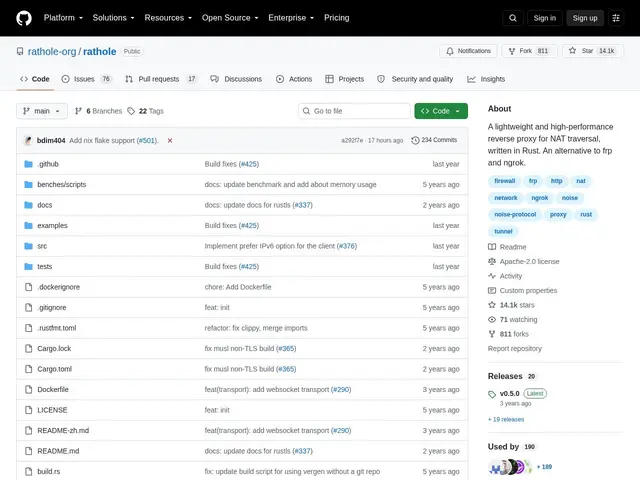
Description
A home server, NAS, or Raspberry Pi behind a home router isn't reachable from the internet without extra work, because NAT hides it from the outside world. Rathole solves that specific problem: it punches a stable tunnel through NAT so services on a machine you don't control the network for can still be reached securely.
Rathole is a reverse proxy for NAT traversal written in Rust, similar in purpose to frp or ngrok but built for performance and memory safety. It supports multiple transport protocols (TCP, TLS, the Noise protocol, and WebSocket), hot-reload configuration so services can be added or changed without restarting the tunnel, and mandatory service-level tokens for authentication. With 14,100 GitHub stars and 234+ commits, it has a large, active community for a networking tool in this space.
💬 Our review
The short version: Rathole is a fast, well-regarded self-hosted alternative to ngrok for anyone who wants to expose a home server or NAS to the internet without paying a subscription or trusting a third party's tunnel.
Against ngrok, which is free for casual use but adds cost and limits at scale, Rathole is completely free and requires only a cheap VPS with a public IP to act as the relay — a one-time setup cost rather than a recurring fee. Compared to frp, a similar open-source alternative written in Go, Rathole's Rust implementation focuses specifically on performance and memory safety, plus it supports the Noise protocol for lightweight encrypted tunnels. The tradeoff versus ngrok is convenience: you need your own relay server, where ngrok's hosted service works out of the box. For a homelab operator comfortable running a small VPS, Rathole is an excellent, free NAT-traversal tool; for quick, zero-setup public tunnels without owning any server, ngrok remains simpler.
💰 Pricing
📊 Global score
🤖 AI-enriched data
Auto-hébergé gratuit, nécessite un VPS pour le relais
Pros
Écrit en Rust, performant et sûr en mémoire
Plusieurs protocoles de transport (TLS, Noise, WebSocket)
Reconfiguration à chaud
Communauté large et active
Cons
Nécessite son propre serveur relais
Pas d'offre hébergée
Configuration initiale plus technique qu'ngrok