OpenFreeMap
Free, open-source map tiles built on OpenStreetMap data — no API key, no usage limits, no tracking.
🔗 Visit OpenFreeMap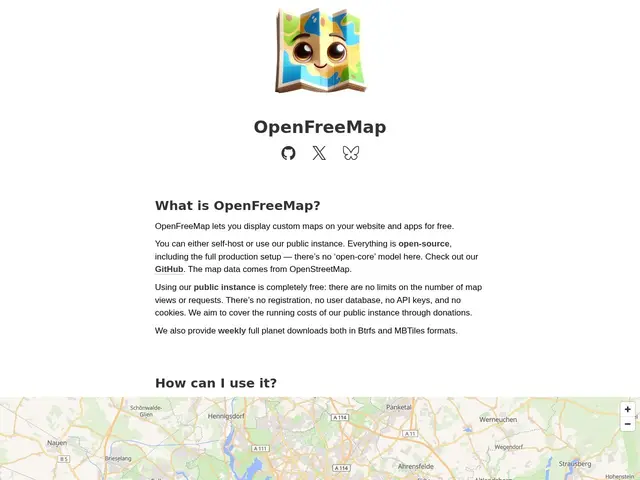
Description
Adding a map to a website usually means signing up for a mapping API, handing over a credit card, and watching usage-based billing creep up as traffic grows. OpenFreeMap exists specifically to remove that step: it's a public map tile service with no API key, no usage cap, and no bill, ever.
OpenFreeMap is built entirely on open-source software and OpenStreetMap data, with no open-core model holding back features. It offers a free public instance usable directly in any website or app, several ready-made styles (Positron Bright, Liberty Dark, Fiord 3D), and weekly full-planet downloads in Btrfs and MBTiles formats for anyone who wants to self-host the whole pipeline instead. Commercial usage is explicitly permitted, there's no tracking or cookies involved, and the project is sustained through voluntary donations rather than a paywall.
💬 Our review
The short version: OpenFreeMap is a genuinely free alternative to Google Maps or Mapbox for anyone who just needs map tiles on a website and doesn't want a metered API key hanging over the project.
Against Mapbox or Google Maps, the tradeoff is support and polish versus cost: OpenFreeMap has no SLA, no dedicated support team, and a smaller style library, but it also has zero usage-based billing risk — a real concern for side projects and small businesses that have been burned by a traffic spike triggering an unexpected map API bill. Compared to other OSM-based free tiers like MapLibre's demo tiles, OpenFreeMap's commitment to unlimited usage and full self-hosting instructions (with weekly planet downloads) gives it more staying power for production use. For a developer who wants basic, attractive maps without billing risk, OpenFreeMap is an easy yes; teams needing enterprise support, custom styling services, or specialized data layers (traffic, transit) should stick with Mapbox or Google Maps.
💰 Pricing
📊 Global score
🤖 AI-enriched data
Instance publique gratuite et illimitée, auto-hébergement possible
Pros
Gratuit et illimité, sans clé API
Basé sur des données OpenStreetMap ouvertes
Aucun tracking
Auto-hébergement documenté
Cons
Pas de support commercial dédié
Moins de styles que Mapbox
Pas de couches spécialisées (trafic, transit)