Chisel
Fast TCP/UDP tunnel over HTTP, secured via SSH, packaged as a single Go binary for both client and server.
🔗 Visit Chisel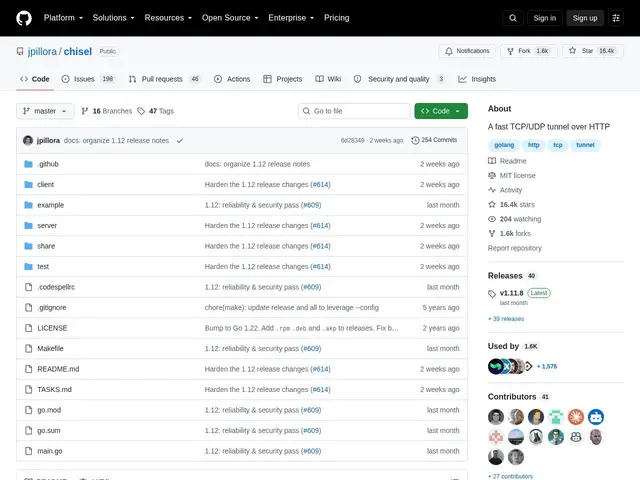
Description
Getting through a restrictive firewall or corporate proxy to reach a service on another network is a recurring headache for developers and sysadmins, and most solutions require installing something heavy. Chisel is deliberately the opposite: one small compiled binary that acts as both client and server for a secure tunnel.
Chisel is a TCP/UDP tunnel transported over HTTP and secured using the SSH protocol, written in Go and distributed as a single executable with no separate dependencies. It supports authenticated client connections through a configurable users file, automatic client reconnection with exponential backoff, SOCKS5 proxy support, reverse port forwarding, TLS/Let's Encrypt for encrypted web endpoints, and multiple tunnel endpoints multiplexed over a single TCP connection. With 16,400 GitHub stars and continued active development, it's one of the more established tools in this specific niche.
💬 Our review
The short version: Chisel is a mature, widely-trusted tool for tunneling traffic through firewalls and NAT, valued specifically for being a single dependency-free binary that's easy to drop onto a restricted machine.
Against SSH port forwarding done manually, Chisel adds real conveniences: automatic reconnection, SOCKS5 proxying, and the ability to tunnel over plain HTTP when SSH ports are blocked, since it rides on top of HTTP which is rarely restricted. Compared to newer Rust-based alternatives like Rathole, Chisel has a much longer track record (16.4k stars, years of production use, including reported use in penetration testing and CTF contexts) though it's written in Go rather than Rust. For developers or sysadmins needing a proven, single-binary tunnel through restrictive networks, Chisel remains a go-to choice; for greenfield NAT-traversal setups with more transport protocol options, Rathole is worth comparing.
💰 Pricing
📊 Global score
🤖 AI-enriched data
Auto-hébergé gratuit
Pros
Binaire unique sans dépendances
Tunnel via HTTP, contourne les pare-feux
Proxy SOCKS5 et redirection de port inversée
Projet mature et largement utilisé
Cons
Pas d'offre hébergée
Configuration en ligne de commande uniquement
Écrit en Go, pas en Rust