FeedLog
Free, open-source feedback and roadmap platform with AI duplicate detection and automated changelogs.
🔗 Visit FeedLog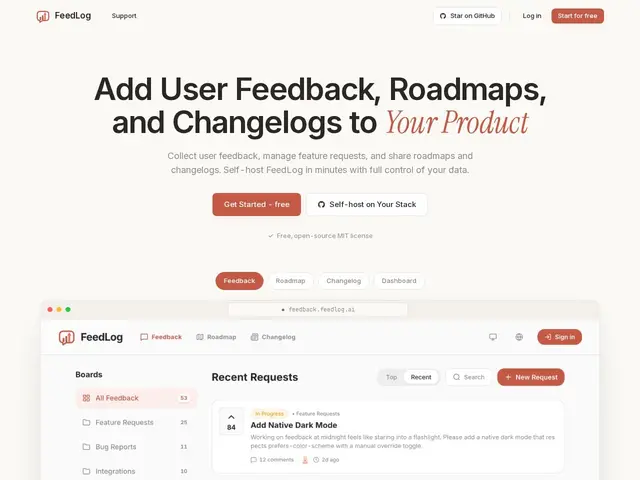
Description
Feedback tools like Canny work well until the monthly bill starts scaling with your user base, which is an awkward incentive for a tool whose whole job is listening to your customers. FeedLog is built as a free, open-source, self-hostable alternative that doesn't charge more as your feedback volume grows.
FeedLog lets teams collect user feedback, manage feature requests, publish public roadmaps, and post changelogs, with AI features doing some of the manual triage work: semantic duplicate detection groups similar requests automatically, and a changelog AI assistant helps draft release notes. It's self-hostable via Docker, Cloudflare Workers, or Vercel, runs on PostgreSQL with the pgvector extension powering its AI features, and offers full data export with no vendor lock-in — both the cloud version and self-hosted deployments are free with unlimited usage.
💬 Our review
The short version: FeedLog is a genuinely compelling free alternative to Canny for startups and open-source projects, with AI-assisted duplicate detection that's usually a paid feature elsewhere.
Against Canny, which gauges pricing by monthly tracked users and gates AI features behind higher tiers, FeedLog's unlimited free usage (cloud or self-hosted) removes the scaling cost entirely, and semantic duplicate merging is included rather than upsold. The tradeoff is maturity: Canny has years of polish, integrations, and enterprise features that a newer open-source project won't match yet, and self-hosting FeedLog means you're responsible for the Postgres/pgvector stack. For an indie hacker or startup that wants a real feedback and roadmap tool without a growing subscription, FeedLog is a strong pick; teams needing deep enterprise integrations and dedicated support should stick with Canny or Featurebase.
💰 Pricing
📊 Global score
🤖 AI-enriched data
Gratuit et illimité, en cloud ou auto-hébergé
Pros
Gratuit et illimité
Détection de doublons par IA
Auto-hébergeable (Docker, Cloudflare, Vercel)
Export complet des données
Cons
Moins mature que Canny
Auto-hébergement nécessite Postgres + pgvector
Écosystème d'intégrations plus restreint