RestQA
A free, open-source way to write API tests in plain English sentences (like "Given the user is logged in, When they call /orders, Then they get a 200") instead of test code.
🔗 Visit RestQA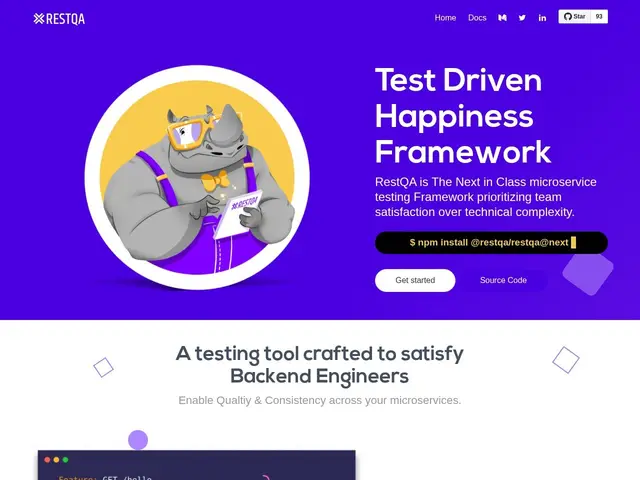
Description
Writing API tests usually means writing code — assertions, setup, teardown — that only other developers can read. RestQA takes a different approach: you describe what the API should do using Gherkin, a plain-English format ("Given / When / Then"), and RestQA turns that into an actual automated test. The result is a test suite that a non-technical teammate can read and understand, not just a developer.
RestQA is an open-source microservice testing framework built around behavior-driven development (BDD). It centralizes reporting with performance metrics, code coverage, and generated API documentation, so a single test run produces both verification and documentation as a byproduct. It's aimed at backend engineers, technical leads, and QA professionals who want microservice testing that doesn't require deep test-framework expertise to read or write, and who value team-wide readability over raw technical flexibility.
💬 Our review
The short version: if your team already writes (or wants to write) Gherkin-style specs for behavior, RestQA turns those specs directly into runnable API tests for free — a solid pick when readability across technical and non-technical teammates matters more than flexibility.
Against Postman, which dominates API testing but requires learning its own scripting/assertion syntax and pushes teams toward its paid collaboration tiers, RestQA's Gherkin-first approach and zero-cost open-source model are the draw — anyone on the team can read a test scenario without knowing JavaScript. Against Karate, a more mature and heavily-adopted framework that also uses Gherkin syntax but bundles UI automation, performance testing, and mocks into one tool, RestQA is narrower in scope (API testing specifically) and has a smaller community, which means fewer integrations and less battle-tested tooling around edge cases. If your testing needs are API-only and BDD-readability is the priority, RestQA is worth trying; if you need the broader unified framework, Karate's larger ecosystem is the safer long-term bet.
💰 Pricing
📊 Global score
🤖 AI-enriched data
Open-source, gratuit, aucun palier payant
Pros
100% gratuit et open-source
Syntaxe Gherkin lisible par des non-développeurs
Documentation API et couverture générées automatiquement
Cons
Périmètre plus étroit que Karate (API uniquement)
Communauté plus petite, moins de plugins/documentation