Qlane
An AI tester that opens a real browser on every pull request, clicks through your app like a human would, and files a bug report with screenshots when something breaks.
🔗 Visit Qlane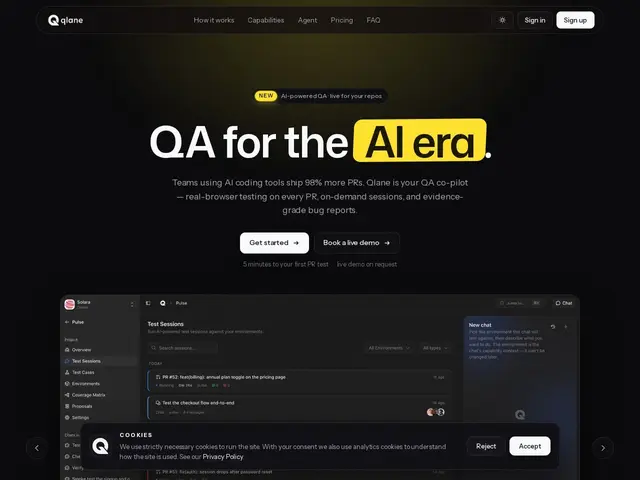
Description
When a team ships code faster than people can manually click through every screen to check it still works, bugs slip through. Qlane is like hiring an extra QA tester who never sleeps: every time someone opens a pull request, it reads the code changes, decides what should be tested, drives a real web browser through those flows, and writes up anything broken with a screenshot and the exact steps to reproduce it — before a human ever has to.
Qlane reads each PR diff and drafts the test cases that should exist; those drafts only become active, tracked tests once a human merges the PR, which keeps the test suite from drifting away from what the app actually does. Tests run in isolated sandboxes using Playwright under the hood, and every reported bug ships with a screenshot, the click path that triggered it, and a severity rating grounded in user impact rather than a generic pass/fail. It's built for the post-AI-coding-assistant world, where teams using tools like Cursor or Claude Code are shipping far more pull requests than their review capacity can manually verify.
💬 Our review
The short version: if your team's bottleneck has shifted from writing code to reviewing and testing it, Qlane automates the part nobody has time for anymore — real-browser verification on every PR — but at €249-699/month for a handful of seats, it's priced for teams that have already outgrown manual QA, not solo builders.
Against QA Wolf, which sells fully-managed human-plus-AI test suites at a higher price point with more hand-holding, Qlane is the self-serve, engineering-owned alternative: you get the automation without the service layer, which is cheaper but means your team still owns triage. Compared to Meticulous or Reflect.run, which focus on visual regression and session replay respectively, Qlane's edge is that it reasons about the PR diff itself to decide what to test, rather than relying on pre-recorded flows — useful when your app changes fast, less useful if you need deep visual-diff coverage. The credit-based pricing (€1/credit, no volume discount even at the top tier) is worth modeling against your actual PR volume before committing, since a high-traffic repo could burn through the Starter tier's 200 credits quickly.
💰 Pricing
📊 Global score
🤖 AI-enriched data
Starter 249€/mois, Pro 699€/mois, Enterprise sur devis — crédits à 1€ l'unité, sans remise de volume
Pros
Test réel en navigateur sur chaque pull request, sans QA manuelle
Rapports de bug avec captures d'écran et chemin de reproduction exact
Génération de tests à partir du diff de la PR, pas de flows pré-enregistrés
Cons
Prix d'entrée élevé (249€/mois) pour seulement 3 sièges
Aucune remise de volume sur les crédits, même en Enterprise