Cronloop
Describe a recurring job in plain English, and Cronloop runs an AI agent to do it on a schedule — every 5 minutes to once a week — remembering what it did last time.
🔗 Visit Cronloop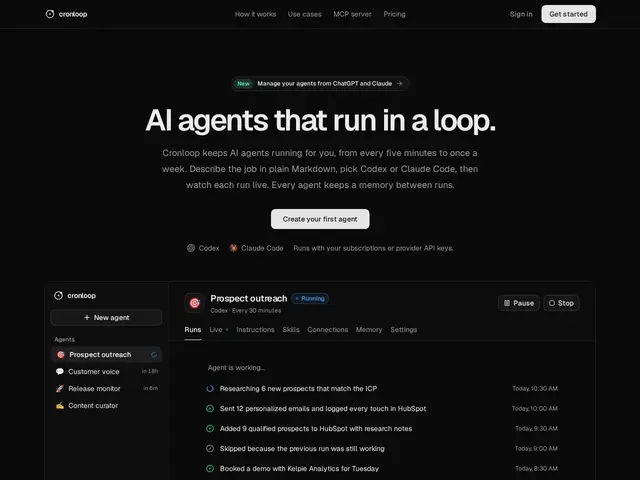
Description
Most automation tools need you to wire together triggers and actions in a visual builder before anything runs. Cronloop skips that: you write what you want done in plain Markdown, pick an AI model (Codex or Claude Code), connect the tools it needs, and it just runs on the schedule you set, checking its own memory of past runs so it can improve over time instead of repeating the same mistakes.
Under the hood, Cronloop schedules AI agents from every 5 minutes to once a week, executing each run in a sandboxed environment with access to 200+ connectors (any tool exposing an MCP, CLI, SDK, or API — including Gmail, HubSpot, GitHub, and Notion). Every agent keeps a durable memory system across runs, which is what separates it from a simple cron job calling an LLM once: it can notice patterns, adjust its own approach, and carry context forward. The free tier caps you at 3 agents and 200 run-minutes a month; the $25/month Pro tier removes the agent cap and drops the minimum interval to 5 minutes.
💬 Our review
The short version: Cronloop is a genuinely low-friction way to turn a recurring task you'd normally script or do by hand into a self-improving AI agent, and the free tier (3 agents, hourly scheduling) is generous enough to actually try it before paying anything.
Against ClawTick and CronBox — two similarly-positioned "cron jobs for AI agents" tools that launched around the same time — Cronloop's differentiator is the persistent memory system that lets agents self-improve between runs, rather than treating each execution as stateless. That's a real edge for jobs where context matters (a support triage agent that remembers recurring issue patterns, for example) but adds little for simple, stateless tasks like a daily status ping. Compared to a general automation platform like Zapier, Cronloop trades visual-builder breadth for AI-native flexibility: you're not chaining pre-built triggers, you're describing intent and letting an LLM figure out the steps, which is more powerful but also less predictable — worth testing on a low-stakes job first before trusting it with anything customer-facing.
💰 Pricing
📊 Global score
🤖 AI-enriched data
Gratuit (3 agents, 200 min/mois) ; Pro 25$/mois ou 20$/mois annuel (agents illimités, cycle 5 min)
Pros
Mémoire persistante — les agents s'améliorent entre les exécutions
200+ connecteurs (MCP, CLI, SDK, API) vers les outils courants
Palier gratuit réellement utilisable, pas juste une démo
Cons
Cycle minimum horaire sur le palier gratuit, 5 min réservé au payant
Exécution pilotée par IA moins prévisible qu'un flow d'automatisation classique