Embedenv
A widget you drop into a blog post, doc page, or course that turns a static code snippet into a real, runnable program a reader can click "Run" on, without leaving the page.
🔗 Visit Embedenv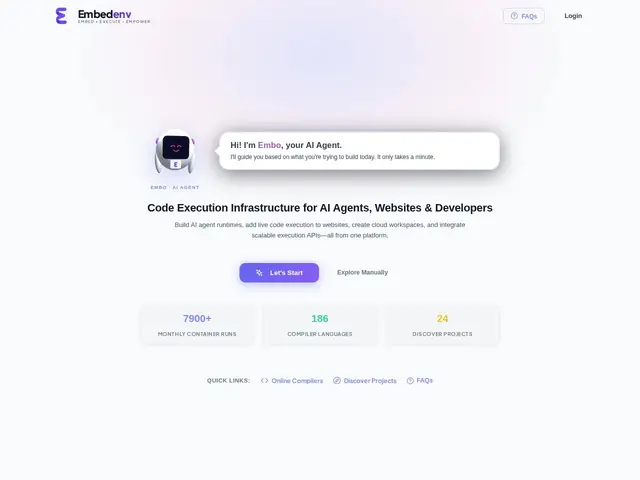
Description
A code snippet on a tutorial page is usually just a picture of code — the reader has to copy it, open their own editor, install whatever it needs, and run it themselves before they can see what it actually does. Embedenv skips all of that: it embeds a real, sandboxed environment right in the page, so a visitor can press "Run" and watch the code actually execute, right there.
Embedenv is an embeddable interactive code playground and sandboxed compiler for websites, documentation, and learning platforms. It supports a wide range of targets — Python, JavaScript, C, Java, Groovy, Spring Boot, Android, LaTeX, and Pygame among others — and executes every run inside an isolated, resource-limited sandbox container, so untrusted reader input never touches the host running the page. It's aimed at technical writers, doc sites, coding bootcamps, blogs, and portfolios that want to prove a code sample actually works instead of just showing it, and it also positions itself as infrastructure for LLM agents that need a safe place to execute generated code.
💬 Our review
The short version: if you maintain documentation or a course where readers keep asking "does this code actually work?", embedding a live Embedenv playground answers that question for them instantly — but the credit-based, per-Run pricing means cost scales directly with how many people actually try your examples, which is worth modeling before rolling it out site-wide.
Against Codapi, which advertises a simple flat free tier (1,000 runs/month) plus a $5/month paid tier, Embedenv's undisclosed credit pricing is the bigger risk for budget-conscious teams — you're committing before knowing the real cost at scale. Its edge is language breadth: JVM-based stacks, Android, and LaTeX aren't things most lightweight embeddable playgrounds support, so for docs covering enterprise Java or mobile development it may be the only realistic option. For a typical JS/Python tutorial site, Codapi's transparent pricing is the safer default; reach for Embedenv when your content specifically needs a language or runtime the simpler tools don't cover.
💰 Pricing
📊 Global score
🤖 AI-enriched data
Système de crédits, 1 crédit par exécution ('Run') ; grille tarifaire des packs non publiée
Pros
Exécution réelle en sandbox isolé, pas une simulation
Support de langages variés au-delà de JS/Python
Conçu aussi pour l'exécution de code par des agents IA
Cons
Grille tarifaire peu transparente
Coût à l'usage qui augmente avec le trafic sur la documentation