RecoverPing
Sends a text message instead of an email when a customer's Stripe subscription payment fails, so they see it on their lock screen and fix it in one tap instead of missing yet another billing email.
🔗 Visit RecoverPing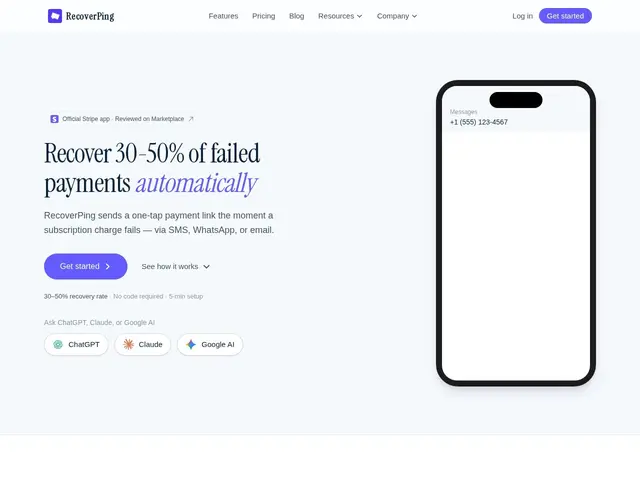
Description
When a subscription payment fails, the standard response is an email — and emails about failed payments are exactly the kind of message people ignore, mark as spam, or genuinely never see, which is a big reason why subscription businesses lose a real chunk of revenue to "involuntary churn" every month. RecoverPing's whole premise is that a text message lands very differently: it shows up on the lock screen in seconds, and a one-tap link lets the customer fix their card without even opening your app.
RecoverPing is a Stripe-integrated failed-payment recovery tool that detects declined charges via webhooks and automatically sends SMS, WhatsApp or email messages with a one-tap link to Stripe's Customer Portal, so customers can update their card and trigger an automatic retry without logging into your app. It runs a customizable 3-step recovery sequence with adjustable delays (e.g., SMS after 1 hour, email after 24 hours, final SMS after 3 days), handles US 10DLC carrier compliance and TCPA opt-in requirements automatically, and provides a recovery-analytics dashboard — set up in about 5 minutes with no code required.
💬 Our review
The short version: RecoverPing is a cheap, fast win if you're running Stripe subscriptions and relying only on Stripe's built-in email dunning — SMS genuinely gets seen faster than email, and at $19-99/month it's a low-risk thing to test against your current recovery rate.
Its direct competitors are ChurnBuster and Churnkey, both more established players offering broader retention tooling (cancellation flows, save offers) beyond just payment recovery — RecoverPing is narrower and cheaper, focused specifically on the SMS/WhatsApp channel advantage. The company's claimed 30-50% recovery rate is a plausible range for dunning tools generally but is self-reported and will vary heavily by your specific customer base and price point. The real question isn't whether SMS recovery works — multiple independent sources confirm SMS beats email for exactly this use case — it's whether you need RecoverPing's narrow tool or a broader retention platform like Churnkey that also handles cancellation flows. If failed-payment recovery is your only gap, RecoverPing's $19/month Starter plan pays for itself by recovering just one or two subscriptions a month for most SaaS pricing.
💰 Pricing
📊 Global score
🤖 AI-enriched data
Starter: $19/month (50 SMS/WhatsApp messages). Growth: $49/month (200 messages, labeled best value). Scale: $99/month (500 messages).
Pros
SMS/WhatsApp lands on the lock screen, meaningfully higher visibility than email dunning
One-tap link to Stripe Customer Portal — no app login required to fix a card
US 10DLC compliance and TCPA opt-in handled automatically
5-minute, no-code setup and low entry price ($19/month)
Cons
Claimed 30-50% recovery rate is self-reported, not independently verified
Narrower scope than Churnkey, which bundles cancellation/retention flows too
Message quotas (50/200/500 per tier) could be limiting for larger subscriber bases