Markup.io
Collaborative annotation platform for giving visual, contextual feedback on websites, images, PDFs, and videos across teams.
🔗 Visit Markup.io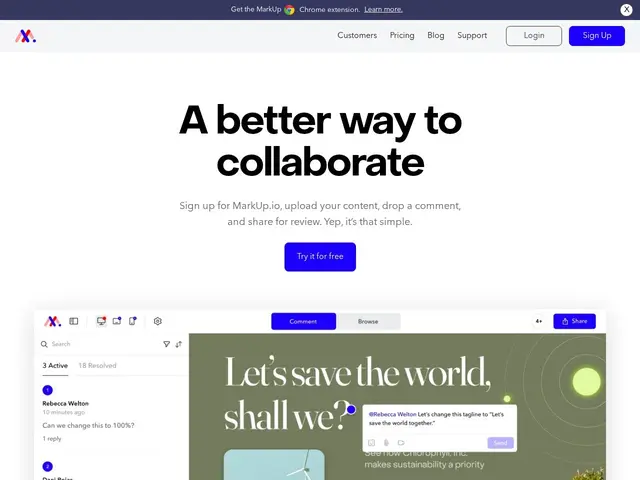
Description
Feedback like 'the logo should be bigger, somewhere near the top' is nearly useless to whoever has to act on it — which 'top'? how much bigger? Markup.io's whole premise is that feedback attached directly to the exact spot on the exact file is faster to give and impossible to misread.
Markup.io is a collaborative review tool that lets teams leave pinned, contextual comments directly on websites, images, PDFs, and videos — over 30 file types in total — instead of describing a location in a chat message. A Chrome extension lets you mark up any live webpage in place, and reviewers without an account can be invited as guests, which matters when feedback needs to come from clients or stakeholders who won't sign up for a new tool. It's aimed at marketing, design, and web teams running review cycles with multiple stakeholders, with the tool's own claim being up to an 80% reduction in the number of review rounds needed to reach approval.
💬 Our review
The short version: Markup.io is a mature entry in a genuinely crowded category — pinned visual feedback on live content — and its main strength over rivals is breadth of file-type support (30+, including video and PDF, not just websites).
Against BugHerd, which leans harder into turning feedback into developer-ready tickets, and Usersnap, which pushes further into bug-tracking integrations, Markup.io stays closer to pure review-and-approval workflows for marketing and creative teams rather than engineering handoff — that's a real distinction, not just branding. Its guest-access model (no signup required to leave feedback) is a genuine advantage when your reviewers are clients rather than colleagues. The tradeoff is that if your team actually needs feedback routed into Jira or Linear as structured tickets, tools built for that handoff (BugHerd, or newer QA-focused tools like OverlayQA) will save more time downstream. Good fit for creative/marketing review cycles with external stakeholders; less ideal if engineering is the primary audience for the feedback.
💰 Pricing
📊 Global score
🤖 AI-enriched data
Essai gratuit (carte bancaire requise), puis paliers payants
Pros
Support de plus de 30 types de fichiers (web, images, PDF, vidéo)
Extension Chrome pour annoter des pages en direct
Accès invité sans création de compte
Réduit les cycles de révision selon l'éditeur
Cons
Carte bancaire requise dès l'essai gratuit
Moins orienté ticket développeur que BugHerd
Marché très concurrentiel