ZinTrust
A zero-dependency TypeScript framework for building production-ready APIs and microservices with clean architecture already in place.
🔗 Visit ZinTrust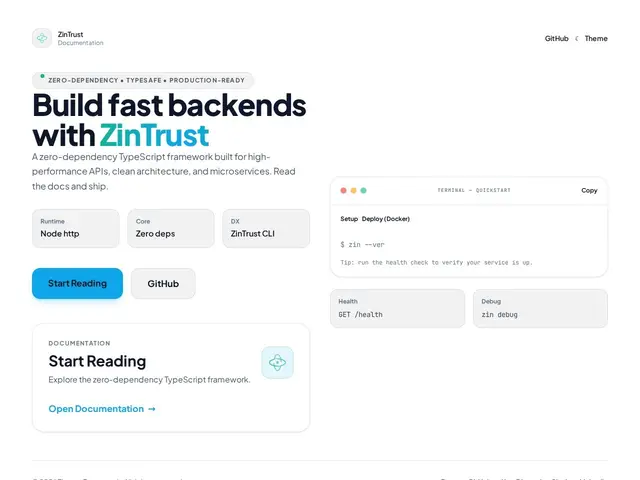
Description
Building the server side of an app — the part that handles requests, checks who's allowed to do what, and talks to a database — usually starts with picking a framework: a pre-built foundation you build your own code on top of, instead of writing all that plumbing from scratch. ZinTrust is one of those foundations, aimed at developers who write their backend in TypeScript and want a clean starting point without pulling in a pile of other people's libraries to get there.
ZinTrust is a zero-dependency TypeScript framework for building production-ready APIs and microservices with clean architecture patterns baked in. It ships with its own CLI for scaffolding projects, a Node.js-based HTTP runtime, and built-in health-check endpoints so a new service is deployable and monitorable from the first commit. "Zero dependency" means the framework itself doesn't pull in a chain of third-party npm packages just to run — which shrinks the attack surface and the number of things that can break in an update. It's free and fully open source on GitHub, aimed at backend developers and teams building microservices who want structure without the weight of a larger framework.
💬 Our review
The short version: if you write backend TypeScript and want a lean, dependency-free starting point with sane structure already in place, ZinTrust gives you that without asking you to buy into a large opinionated ecosystem.
The zero-dependency claim is the real selling point — most Node frameworks quietly depend on dozens of transitive packages, and each one is a future supply-chain risk or breaking change waiting to happen. ZinTrust avoids that, at the cost of being much younger and far less battle-tested than Express, Fastify, or NestJS, all of which have years of production hardening, huge plugin ecosystems, and enormous Stack Overflow coverage behind them. There's no visible pricing because there's nothing to price — it's open source, so the real cost is your own time evaluating whether a small framework with a small community is worth the tighter dependency tree. Worth trying on a side project or an internal microservice; risky as the backbone of something mission-critical until it has more track record.
💰 Pricing
📊 Global score
🤖 AI-enriched data
MIT, aucun coût, hébergé sur GitHub
Pros
Zéro dépendance externe (surface d'attaque réduite)
CLI intégré pour scaffolder un projet
Endpoints de health-check prêts à l'emploi
Gratuit et open source
Cons
Écosystème de plugins très réduit comparé à Express/Fastify/NestJS
Projet jeune, peu de retours de production à grande échelle
Documentation moins fournie que les frameworks établis