Hookwise
A developer tool that gives you an instant public URL to capture, inspect, and replay webhooks.
🔗 Visit Hookwise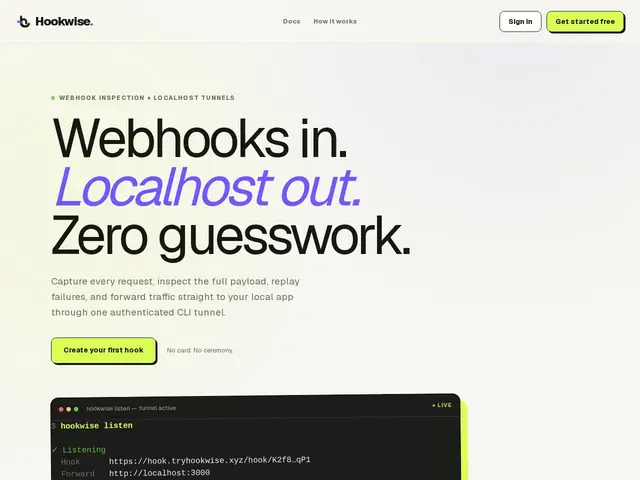
Description
When a service like Stripe or GitHub needs to notify your app that something happened — a payment succeeded, code was pushed — it sends a webhook: an HTTP request to a URL you control. The problem is testing that on your own laptop, since your laptop usually isn't reachable from the internet. Hookwise solves that specific problem: it gives you a public URL that catches those webhooks and forwards them to your local machine so you can see and debug them.
Hookwise is a developer tool for webhook inspection and localhost tunneling. It creates instant public webhook URLs, captures incoming requests from services like Stripe, GitHub, and Shopify, and lets you inspect headers and payloads in real time through a searchable interface. A CLI component tunnels those requests down to your local development environment, and you can replay any past request to re-test a fix without waiting for the real event to fire again — plus delivery metrics showing success rates and latency. It has a free tier with no credit card required, and no other pricing tiers are published on its site yet.
💬 Our review
The short version: if you build integrations with services that send webhooks and you're tired of deploying to a public server just to test them, Hookwise gives you a purpose-built inspector instead of adapting a general-purpose tunnel.
Its main competitor, by its own admission, is ngrok — which is the default choice for exposing localhost to the internet generally, but is a generic tunnel, not a webhook-specific tool. Hookwise's edge is the webhook-focused UI: searchable payload/header inspection and one-click replay are things you'd otherwise have to build yourself on top of ngrok's raw tunnel. The trade-off is scope and maturity — ngrok does far more than webhooks (custom domains, load balancing, broader protocol support) and has years more production use behind it, while Hookwise's free tier and lack of published paid plans suggest it's still finding its pricing model. Worth adopting specifically for webhook-heavy integration work (Stripe, Shopify, GitHub); for general localhost exposure beyond webhooks, ngrok remains the safer, more established choice.
💰 Pricing
📊 Global score
🤖 AI-enriched data
Offre gratuite sans carte bancaire ; aucun palier payant publié pour l'instant
Pros
Inspection en temps réel des payloads et headers, recherche incluse
Rejeu de requêtes passées sans attendre l'événement réel
Tunneling CLI vers l'environnement local
Métriques de livraison (taux de succès, latence)
Cons
Aucun palier payant publié pour l'instant (modèle encore incertain)
Portée plus étroite qu'un tunnel généraliste comme ngrok
Moins de recul en production que des outils établis