Swift AI SDK
An open-source Swift package giving Apple-platform developers one unified interface to a dozen+ AI providers.
🔗 Visit Swift AI SDK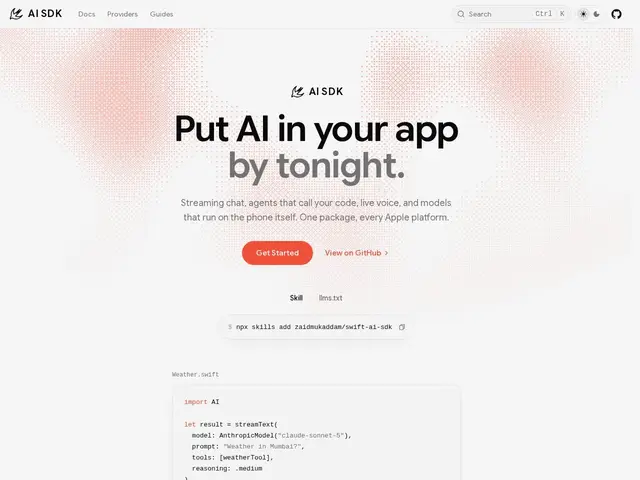
Description
Adding AI chat or voice features to an iPhone or Mac app usually means writing separate glue code for every AI provider you might want to support — one integration for a company's models, another for a different one, each with its own quirks. Swift AI SDK collapses that into a single package: write your AI feature once, and switch between providers without rewriting it.
Swift AI SDK is an open-source, MIT-licensed Swift package that gives Apple platform developers a single interface for AI features across iOS, macOS, visionOS, tvOS, and watchOS. It supports more than a dozen model providers — including Claude, GPT, Gemini, Grok, and locally-run Ollama models — through one unified API, with streaming text, an agent framework that supports tool-calling and conversation history compaction, and live voice interaction over WebSockets. It can also run Apple's on-device Intelligence models directly, falling back to the cloud automatically when needed, and ships a ready-made ChatSession UI component so a working chat interface doesn't require building one from scratch. It's free, with no paid tier — you pay only for whichever underlying AI provider's API you choose to call.
💬 Our review
The short version: if you're building an Apple-platform app and want to support several AI providers without maintaining separate integrations for each, Swift AI SDK is a genuinely useful abstraction layer — and it costs nothing beyond the API usage you'd pay anyway.
Its closest competitor is Apple's own Foundation Models framework, which is tightly integrated but locked to Apple's own on-device models; Swift AI SDK's multi-provider support and cloud fallback give it more flexibility if you want access to Claude, GPT, or Gemini specifically, or want to swap providers later without a rewrite. Compared to calling each provider's own SDK directly, you trade a small amount of control for a lot less boilerplate and a consistent chat/voice/agent interface across all of them. The risk with any young multi-provider abstraction is provider drift — when one vendor changes its API, the wrapper has to catch up, so check how actively it's maintained before betting a shipping app on it. Good fit for indie developers and small teams building AI features across Apple platforms who don't want vendor lock-in; less relevant if you're deeply committed to a single provider's native SDK already.
💰 Pricing
📊 Global score
🤖 AI-enriched data
MIT, gratuit — seul le coût des API des fournisseurs IA sous-jacents s'applique
Pros
Interface unique pour 8+ fournisseurs IA (Claude, GPT, Gemini, Grok, Ollama...)
Modèles on-device Apple Intelligence avec fallback cloud automatique
Composant ChatSession prêt à l'emploi
Gratuit, MIT
Cons
Dépend du rythme de mise à jour face aux changements d'API des fournisseurs
Moins de contrôle fin que les SDK natifs de chaque fournisseur
Communauté encore jeune