ApiRift
A monitoring service that automatically tracks breaking changes and deprecations across your external API dependencies.
🔗 Visit ApiRift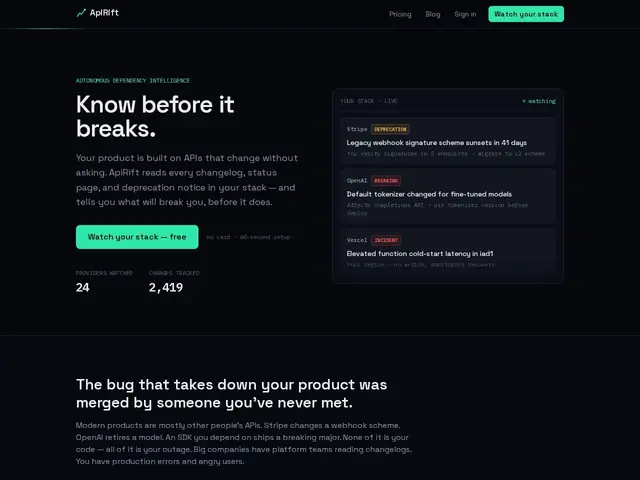
Description
Modern apps depend on dozens of external APIs — payment processors, mapping services, AI providers — and those APIs change over time: features get deprecated, versions get sunset, pricing policies shift. Usually you find out the hard way, when something breaks in production. ApiRift watches those APIs for you and warns you before a change catches you off guard.
ApiRift is an API monitoring service that automatically tracks changelogs, deprecations, and policy updates across the external API dependencies your app relies on, polling for changes roughly every 30 minutes. It filters alerts by severity — so a critical breaking change reaches you instantly, while minor updates land in a weekly digest — and shows deprecation deadlines as a countdown alongside impact reports naming which of your specific endpoints are affected. It also maintains a shared registry of tracked providers that improves as more users contribute to it. Pricing is freemium: a free tier covers five providers with a weekly digest, a $12/month (or $115/year) Pro tier adds unlimited providers and instant alerts across five projects, and a $29/month (or $278/year) Team tier adds webhooks and scales to 25 projects.
💬 Our review
The short version: if your app relies on a handful of third-party APIs and you've ever been blindsided by a deprecation you didn't know about, ApiRift's automated tracking is cheap insurance against that specific failure mode.
Its real value is proactive coverage: most teams find out about breaking API changes from a support ticket or a broken production feature, not from reading every provider's changelog manually. Compared to generic uptime monitors like UptimeRobot or Better Stack — which tell you an API is down right now — ApiRift answers a different question: is an API about to change in a way that will break you later. The free tier's five-provider limit is a real constraint for anyone with a larger dependency list, and the shared registry's usefulness depends on how many providers are already tracked by other users, which matters more for common APIs (Stripe, Twilio) than obscure ones. Worth it for teams juggling several critical external API dependencies; overkill if you only depend on one or two well-documented, stable APIs.
💰 Pricing
📊 Global score
🤖 AI-enriched data
Gratuit (5 fournisseurs, digest hebdo) ; Pro 12$/mois ou 115$/an (fournisseurs illimités, alertes instantanées, 5 projets) ; Team 29$/mois ou 278$/an (webhooks, 25 projets)
Pros
Suivi automatique des dépréciations et changements d'API toutes les ~30 minutes
Alertes filtrées par sévérité (instantané vs digest hebdo)
Rapports d'impact précis par endpoint
Registre partagé qui s'enrichit avec les contributions
Cons
Palier gratuit limité à 5 fournisseurs
Utilité du registre partagé dépendante de la couverture déjà existante
Ne remplace pas un monitoring d'uptime classique