MCP State Twin
A testing framework that gives AI agents deterministic, forkable, stateful sandboxes — so you can run the same starting state through different tool-call sequences and compare results reproducibly.
🔗 Visit MCP State Twin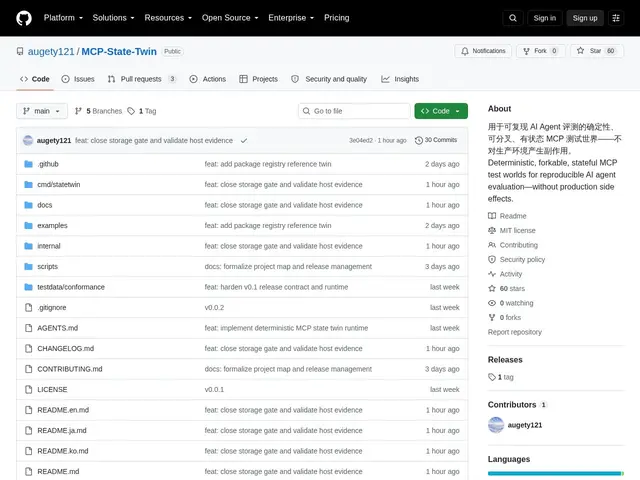
Description
Testing whether an AI agent behaves correctly is hard when every test run happens against a live, changing system — you can't easily tell if a different outcome came from the agent's decision or just because the underlying data shifted. MCP State Twin solves that by giving every test run its own frozen, forkable copy of the starting state.
Built specifically for agents using the Model Context Protocol (MCP), it lets multiple test runs branch from identical immutable snapshots, execute different tool-call sequences in isolation, and then compare the resulting states via assertions and diffs — all without touching production systems. It supports deterministic fault injection and virtual clock advancement for testing time-dependent behavior, uses CEL (Common Expression Language) for defining preconditions and effects, and ships reference domains (an issue-tracker and a package-registry with synthetic data) to test against out of the box. It's written in Go with a SQLite backend and is explicitly labeled a development preview (v0.1.0-alpha), not production-ready.
💬 Our review
The short version: MCP State Twin addresses a real gap in agent testing — reproducible, comparable evaluation of stateful tool interactions — that generic testing frameworks like pytest or Jest weren't built for, since they don't model forkable, comparable world-state snapshots.
Against rolling your own test fixtures in pytest or Jest, the advantage is purpose-built primitives (immutable snapshots, forking, state diffing, fault injection) instead of hand-rolled mocking. Against Docker-based test environments, it's lighter weight and specifically MCP-aware rather than a general container sandbox. The catch is right there in the version number: v0.1.0-alpha, explicitly non-production-ready, with only 60 stars and 30 commits — this is a tool to watch and experiment with, not to build critical CI pipelines on yet. Worth trying now if you're building MCP-based agents and want more rigorous evaluation than manual testing; wait for a stable release if you need something dependable today.
💰 Pricing
📊 Global score
🤖 AI-enriched data
Gratuit, licence MIT, aucune offre commerciale. Statut alpha (v0.1.0).
Pros
Snapshots immuables et forkables pour une évaluation reproductible
Comparaison d'états terminaux via assertions et diffs
Injection de fautes déterministe et avancement d'horloge virtuelle
Domaines de référence prêts à l'emploi (issue-tracker, registre de paquets)
Cons
Statut alpha explicite (v0.1.0), non prêt pour la production
Communauté encore très restreinte (60 étoiles, 30 commits)
Spécifique à MCP, pas un framework de test généraliste