HFlow
An open-source SDK for building robotics data pipelines, managing the collection-to-delivery lifecycle of multimodal sensor data with quality checks and full provenance tracking, backed by Y Combinator.
🔗 Visit HFlow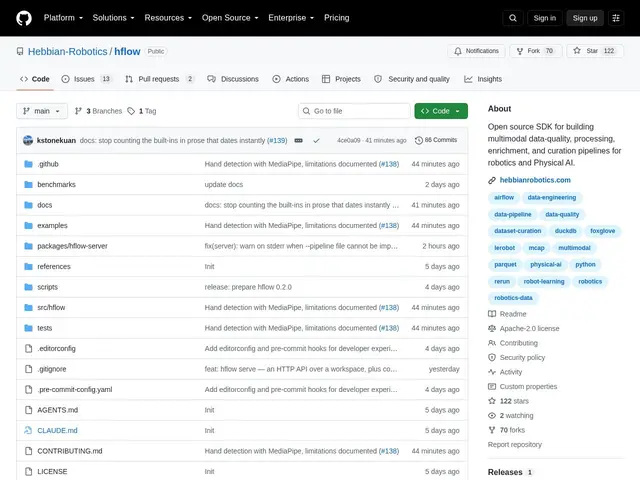
Description
Training robots or "Physical AI" models needs huge amounts of sensor data — camera, lidar, motor telemetry — but that data is messy: it comes from different rigs, needs cleaning, and has to be traceable back to exactly how and when it was recorded. HFlow is built to manage that pipeline end to end instead of gluing together generic data tools.
HFlow structures data through four stages — collection, ingestion, curation, and delivery — for multimodal data in the MCAP container format (native to ROS 2 robotics stacks). It tracks quality evidence and provenance across every stage, generates and visualizes Apache Airflow DAGs, and stores a Parquet-based, version-pinned metadata catalog queryable via DuckDB without needing to load the raw recordings themselves. It runs via Docker Compose with support for S3, GCS, or Azure cloud storage, is Apache 2.0 licensed, and is backed by Y Combinator (S26), co-founded by Brandon Ong and Kingston Kuan with angel investors from Oracle, Google DeepMind, and OpenAI.
💬 Our review
The short version: HFlow targets a genuinely underserved niche — data pipeline tooling purpose-built for robotics and Physical AI, rather than generic data engineering tools retrofitted for sensor data — and it has credible backing (YC S26, investors from major AI labs) for a project this young.
Against generic pipeline tools like Apache Airflow or Prefect, HFlow's advantage is native understanding of MCAP and robotics-specific concepts (multimodal sensor streams, provenance across physical collection sessions) that those tools don't handle out of the box. Against DVC or Pachyderm, which focus on general ML data versioning, HFlow is narrower but deeper for the robotics use case specifically. At pre-v1 (v0.2.0+) with 122 stars, it's early — the core lifecycle is described as functional end-to-end, but expect API changes before a stable release. Worth adopting now if you're a robotics/Physical AI team building your data pipeline from scratch; less compelling if you're already invested in a general-purpose pipeline tool and don't have robotics-specific pain points.
💰 Pricing
📊 Global score
🤖 AI-enriched data
Gratuit, licence Apache 2.0, pas d'offre commerciale publiée.
Pros
Cycle de vie complet (collecte, ingestion, curation, livraison) natif pour données robotique multimodales
Support natif du format MCAP (ROS 2)
Traçabilité et provenance à chaque étape
Backé par Y Combinator S26, investisseurs issus d'Oracle, Google DeepMind, OpenAI
Cons
Pré-v1 (v0.2.0+), API encore susceptible de changer
Niche spécifique à la robotique/Physical AI
Moins généraliste que Airflow ou Prefect