Nuphos
Lets an AI agent investigate and fix your cloud infrastructure — reading logs, opening dashboards, proposing changes — without giving up the approval step a human normally provides.
🔗 Visit Nuphos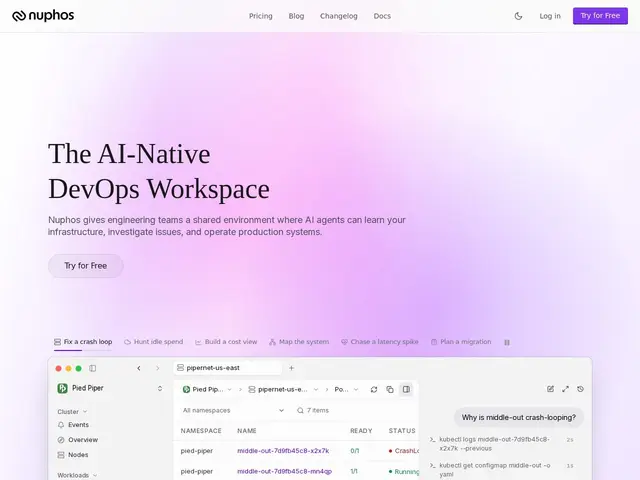
Description
When something breaks in production at 2am, the slow part usually isn't fixing it — it's finding which of your dozen cloud dashboards has the answer. Nuphos gives an AI agent access to your actual infrastructure (AWS, GCP, Cloudflare, and more) so it can investigate incidents, read logs, and draft fixes itself, the way a very fast on-call engineer would, while still routing anything risky through you for approval before it executes.
It connects using each cloud's native IAM roles rather than requiring code changes or migrations, so setup doesn't touch your existing infrastructure. Agents can inspect resources, read logs, open dashboards, generate remediation plans, request approval, and execute changes once approved — with every action logged for audit. It builds a memory of your organization's specific services and workflows over time, and reaches teams through Slack, Discord, or iMessage. Nuphos is SOC 2 certified, backed by Zeabur, used by Y Combinator F25 companies, and integrates with GitHub, GitLab, Linear, Jira, Vanta and Secureframe.
💬 Our review
The short version: Nuphos is betting that most infrastructure toil is investigation time, not fix time — and an agent with real cloud access but a mandatory approval gate is a reasonable way to cut that time without handing over the keys.
Against general-purpose AIOps and observability platforms, Nuphos differentiates by acting, not just alerting — it can draft and (with approval) execute changes, closer to an on-call teammate than a dashboard. The audit trail and approval-required design are the right call for anything SOC 2/ISO-conscious, but it also means the product is only as good as your team's discipline in actually reviewing what it proposes; teams that rubber-stamp approvals lose the safety net. Pricing starts free for a single connector and small teams, scaling to $299–$999/month for real multi-cloud usage — reasonable if it genuinely saves incident-response hours, expensive if your infra footprint is small enough that a human already handles it fine. Best fit: teams already juggling AWS+GCP+Cloudflare with recurring on-call pain; overkill for a single-cloud, single-app setup.
💰 Pricing
📊 Global score
🤖 AI-enriched data
Free (1 connecteur, 3 membres) · Dev 29$/mois · Team 99$/mois (le plus populaire) · Business 299$/mois · Scale 999$/mois · Enterprise sur devis.
Pros
Contrôle IAM natif fin (AWS, GCP, Azure) — zéro migration requise
Workflow d'approbation obligatoire avant toute action risquée, avec piste d'audit
Mémoire persistante des services et workflows spécifiques à l'organisation
Certifié SOC 2, intégrations Vanta/Secureframe pour la conformité
Multi-canal : Slack, Discord, iMessage
Cons
Coût qui grimpe vite au-delà du tier gratuit (299-999$/mois pour usage réel)
L'efficacité dépend de la rigueur de l'équipe à réellement examiner les approbations
Pas d'historique GitHub public pour juger la maturité du code
Overkill pour une infra mono-cloud simple