Ito
AI code review that doesn't just read your diff — it actually runs your app on every pull request and shows you a video of what broke.
🔗 Visit Ito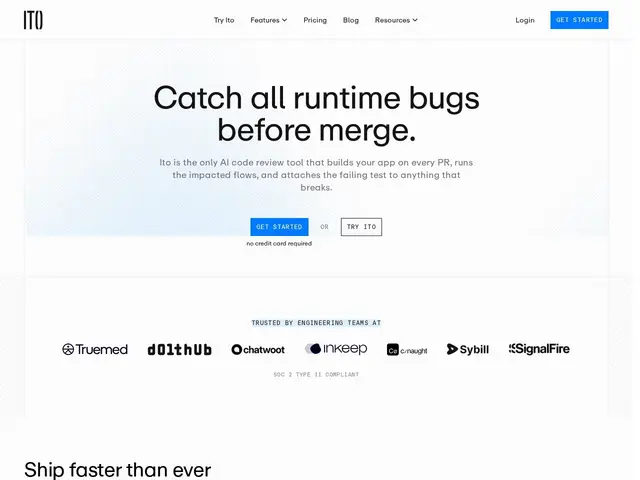
Description
Most AI code review tools read your code and guess what might go wrong. Ito takes a different approach: on every pull request, it spins up your actual application in an isolated sandbox and clicks through it like a real user would, catching bugs that only show up when the app is genuinely running — the software equivalent of a mechanic test-driving your car instead of just reading the repair manual.
Technically, Ito builds your full stack (frontend and backend together) in a sandbox, generates test plans from the PR diff automatically, and uses computer-use agents to simulate real user flows, including authenticated sessions and multi-factor auth. It's framework-agnostic (React, Vue, Next.js, Rails, Django) and produces video evidence plus reproduction steps for every bug found. Ito reports that 81% of the bugs it catches are unique to runtime execution — meaning static analysis tools like SonarQube or linters would have missed them — and claims a 50% reduction in regressions for teams using it. It's SOC 2 Type II certified and used by companies including DoltHub, Truemed, and Inkeep.
💬 Our review
The short version: Ito fills a real gap between static code review (SonarQube, Codacy) and full manual QA — it's the closest thing to "someone actually clicked through your app before merging" that you can automate.
Against static analyzers, Ito's edge is catching runtime-only failures — broken flows, integration bugs, things that only surface when the app executes — which is a fundamentally different category of bug than syntax or pattern-matching tools find; the two are complementary rather than competing. Against manual QA or end-to-end test suites (Playwright, Cypress), Ito trades some precision for zero setup: no test scripts to write and maintain, at the cost of less control over exactly what gets tested. At $40/month for 20 reviews (plus $3 each beyond that), it's priced for teams that ship PRs regularly rather than occasional hobby projects, and the free tier for open-source projects is a fair way to try it without commitment. Teams already running comprehensive E2E suites may find the overlap redundant; teams shipping fast with thin test coverage are exactly who this is built for.
💰 Pricing
📊 Global score
🤖 AI-enriched data
Gratuit pour les projets open-source. Pro : 40$/mois (20 reviews incluses, 3$/review supplémentaire). Entreprise : sur devis. Essai gratuit 20 reviews sans carte bancaire.
Pros
Exécute réellement l'application au lieu de juste lire le code — attrape des bugs runtime invisibles à l'analyse statique
Preuve vidéo + étapes de reproduction pour chaque bug trouvé
Génère les plans de test automatiquement depuis le diff, zéro script à écrire
Certifié SOC 2 Type II, adapté aux secteurs réglementés
Support des flux authentifiés et MFA
Cons
40$/mois + surcoût par review au-delà de 20 : peut monter vite pour une équipe qui merge beaucoup
Pas d'historique GitHub public (0 star) — jeune, peu de recul communautaire
Chevauchement possible avec une suite E2E déjà mature (Playwright/Cypress)
Dépendant du sandbox — configuration initiale nécessaire pour builder l'app complète