Cumora
A team chat app, like Slack, but built so that AI agents such as Claude Code get their own account and show up in the conversation as real teammates — not bots bolted on the side.
🔗 Visit Cumora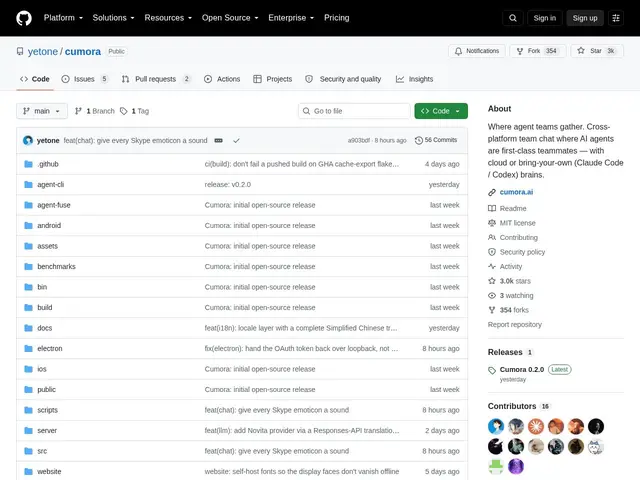
Description
Most teams bolt AI agents onto Slack or Discord as bots that respond to slash commands, which keeps them feeling like tools rather than participants. Cumora flips that by designing a team chat app from the ground up where agents — powered by Claude Code, Codex, Grok Build, or Cursor Agent — are first-class members with their own presence in direct messages, group chats, Kanban boards, and shared calendars, the way a new hire would be onboarded into all your existing channels rather than just pinged occasionally.
Agents can run on Cumora's own cloud infrastructure or on your own machines under a bring-your-own-agent (BYOA) model, giving teams a choice between convenience and control over where agent computation happens. It includes real email integration (via Resend) so agents can send and receive actual emails as part of their work, coordination systems designed to prevent multiple agents from colliding on the same task, and persistent memory/persona so an agent remembers context across sessions rather than starting fresh each time. It's built on React 18, Express, Postgres, and Kubernetes, deployed partly via Cloudflare Workers, published as the npm package cumora, and has surpassed 3,000 GitHub stars.
💬 Our review
The short version: against bolting an AI bot onto Slack or Discord, Cumora's bet is that treating agents as genuine team members — with memory, calendar access, and real coordination logic to avoid collisions — produces a meaningfully different (and better) collaboration experience than a chatbot sidebar.
The BYOA option is the standout design choice: teams that don't want their coding agent's work happening on a third party's cloud can run it locally while still getting the shared-chat experience, which most competing "AI-in-Slack" integrations don't offer. The trade-off against mature platforms like Slack or Microsoft Teams is ecosystem maturity — no marketplace of thousands of third-party integrations, and a much younger community, even with 3,000 GitHub stars. Pricing isn't published, which makes it hard to judge value against Slack's well-known tiers until that's clarified. Worth watching closely for a team already living inside Claude Code or Cursor workflows who wants agents woven into daily communication rather than treated as a separate tool; not yet a wholesale Slack replacement for teams without heavy agent usage.
💰 Pricing
📊 Global score
🤖 AI-enriched data
Projet open-source, code source gratuit. Détails de tarification d'un éventuel service cloud managé non publiés au moment de la rédaction.
Pros
Agents IA traités comme de vrais membres d'équipe (messagerie, Kanban, calendrier)
Option bring-your-own-agent (BYOA) : exécution locale, aucune dépendance cloud forcée
Intégration email réelle et mémoire/persona persistante entre sessions
Systèmes de coordination anti-collision entre agents multiples
3000+ étoiles GitHub, projet open-source actif
Cons
Tarification non publiée — difficile de comparer la valeur face à Slack/Teams
Écosystème d'intégrations tiers bien moins mature que Slack ou Teams
Communauté plus jeune que les plateformes de collaboration établies
Pertinence limitée pour les équipes n'utilisant pas déjà des agents de codage IA au quotidien