x64dbg-MCP Server
Lets an AI assistant like Claude drive the x64dbg debugger for you — setting breakpoints, stepping through code, reading memory — turning manual reverse-engineering grunt work into something you can direct in plain language.
🔗 Visit x64dbg-MCP Server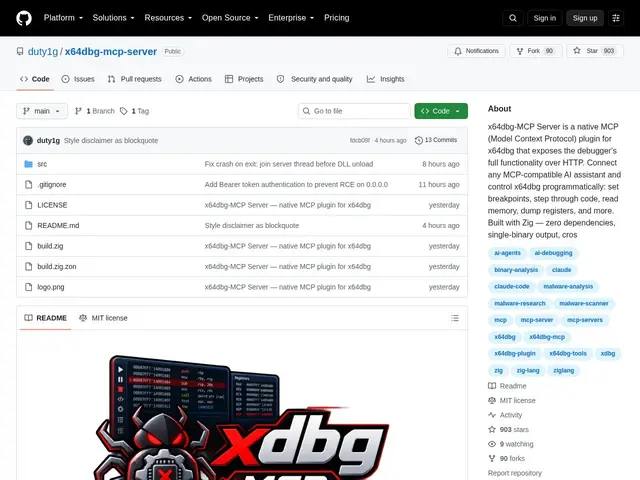
Description
Reverse engineering and low-level debugging normally means manually clicking through a debugger's interface for every breakpoint, memory read, or register check — tedious, repetitive work even for experts. x64dbg-MCP Server exposes the popular Windows debugger x64dbg to AI assistants via the Model Context Protocol, so an AI agent can drive the debugging session directly, similar to how a skilled assistant might operate a piece of lab equipment on your behalf while you focus on interpreting the results.
It provides 71 distinct MCP tools covering disassembly, breakpoints, memory operations, register inspection, and process manipulation, communicating over HTTP or SSE with bearer token authentication and 22 event callback handlers for comprehensive debugger event coverage. Built in Zig specifically to avoid external dependencies, it compiles to a single binary, auto-starts alongside x64dbg, and supports both x32 and x64 architectures across Windows, WSL, Linux, and macOS build targets. It's MIT licensed with roughly 900 GitHub stars, aimed at reverse engineers, security researchers, and malware analysts who want to bring AI assistance into their existing debugging workflow.
💬 Our review
The short version: for anyone already using x64dbg professionally — malware analysts, reverse engineers, security researchers — this turns a chat-based AI assistant into a genuine co-pilot for debugging sessions instead of just a place to paste disassembly and ask questions.
Against alternatives like IDA Pro or Ghidra, which are the disassembly/analysis heavyweights, x64dbg-MCP Server isn't a replacement — it's an automation layer specifically for x64dbg's live debugging workflow, complementary rather than competing. The single-binary Zig build with zero dependencies is a genuinely good engineering choice for a security tool (fewer moving parts to audit or exploit), but the developers themselves flag that it communicates over unencrypted HTTP, which is a real caveat: run it locally or on a trusted network only, never expose it directly to the internet. This is legitimate, well-scoped tooling for defensive/analytical reverse-engineering work; free and open source makes it an easy add for any x64dbg user willing to accept the local-only security posture.
💰 Pricing
📊 Global score
🤖 AI-enriched data
100% gratuit, licence MIT.
Pros
71 outils MCP couvrant l'intégralité des fonctions de x64dbg
Binaire unique en Zig, zéro dépendance externe
Compatible x32/x64, compilation cross-platform (Windows, WSL, Linux, macOS)
22 gestionnaires d'événements pour une couverture complète du débogueur
Authentification par token, transport HTTP et SSE
Cons
Communication en HTTP non chiffré — à n'utiliser qu'en local ou réseau de confiance
N'est pas un outil d'analyse autonome, dépend de x64dbg déjà installé
Niche très spécialisée (reverse engineering), pas pour un usage grand public
Projet porté par un seul développeur