bitdrift Capture
Mobile observability platform that stores telemetry on-device and only uploads what you actually need, giving real-time visibility into iOS/Android app crashes and performance.
🔗 Visit bitdrift Capture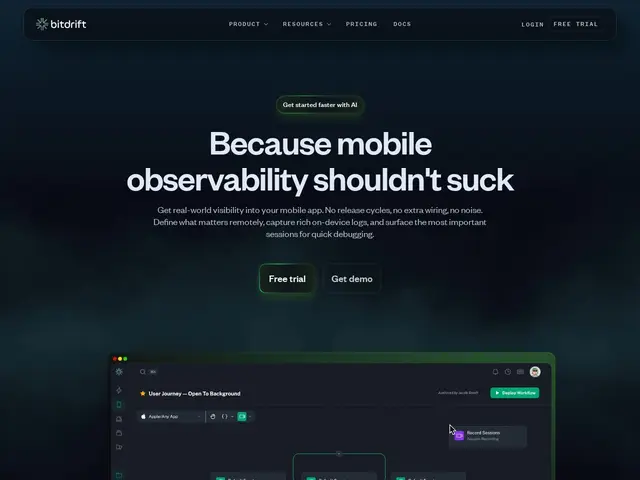
Description
When a mobile app crashes for one user out of a million, most teams either drown in logs they never look at, or don't have the right log at all because they didn't know to collect it ahead of time. bitdrift flips that: instead of shipping everything to the cloud all the time, it keeps detailed telemetry stored on the phone itself and lets you pull exactly what you need, exactly when an incident happens — like a black box flight recorder for an app.
Under the hood, bitdrift Capture ships iOS and Android SDKs that support crash reporting, session replay, log streaming, dashboards, and real-time alerting (Slack, PagerDuty, custom SLOs), plus the ability to change what's being monitored on-device without shipping a new app release. It was built by engineers who previously worked on infrastructure at Lyft, AWS, Twitter, Square, Google, Microsoft, and Netflix, and who created the widely-used Envoy proxy — which shows in the emphasis on solving the industry's real waste problem: most collected mobile telemetry is never actually used.
💬 Our review
The short version: bitdrift's on-device storage model is a genuinely different approach to mobile observability than the 'ship everything to the cloud' model used by Sentry or Firebase Crashlytics, and it's backed by a team with real infrastructure credentials.
Against Sentry, Firebase Crashlytics, or Datadog RUM, bitdrift's pitch is precision and control: because raw telemetry stays on the device, you can reconfigure what you're capturing in real time without an app-store release cycle, and you only pay for what you actually pull — directly addressing the well-known problem that most mobile telemetry collected today is never looked at. The free tier (100,000 crashes/month, 5 users) is genuinely usable for small-to-mid apps, and enterprise pricing scales by monthly active applications rather than seats. The tradeoffs: it's a smaller, younger company than Sentry or Datadog, its GitHub footprint is modest, and switching an established app's crash-reporting pipeline is real engineering work, so the case for migrating has to be about the on-device model specifically, not just 'another crash reporter.'
💰 Pricing
📊 Global score
🤖 AI-enriched data
Gratuit : 100 000 crashs/mois, 5 utilisateurs, rétention 14 jours, 3 workflows personnalisés. Enterprise : sur devis (utilisateurs illimités, crashs illimités, rétention jusqu'à 180 jours, alerting avancé, session replay, SSO). Facturation basée sur le nombre d'applications actives mensuelles, pas de frais de dépassement.
Pros
Stockage de la télémétrie sur l'appareil, contrôle fin de ce qui est réellement transmis
Reconfiguration du monitoring en temps réel, sans nouvelle release de l'app
Équipe fondatrice issue de Lyft/AWS/Twitter/Google/Netflix, créatrice du proxy Envoy
Palier gratuit généreux (100k crashs/mois)
Cons
Entreprise plus petite et jeune que Sentry ou Datadog
Empreinte GitHub modeste comparée aux leaders établis
Migrer un pipeline de crash-reporting déjà en place demande un vrai travail d'ingénierie