Ant
9MB JavaScript runtime with a custom JIT engine, full Node.js compatibility, and the fastest claimed cold start among major runtimes.
🔗 Visit Ant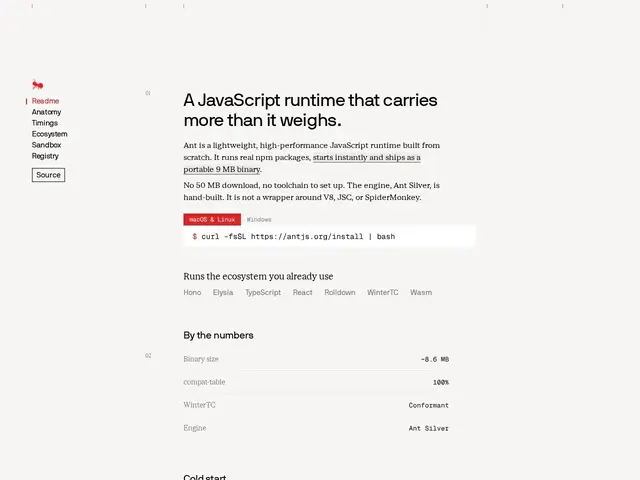
Description
Every JavaScript runtime — Node, Deno, Bun — has been racing to shrink cold-start times and binary size for years, because in serverless and edge computing, a few dozen milliseconds of startup latency directly costs money and user-perceived speed. Ant is a new entrant built specifically around that constraint: a 9MB single binary (smaller than any major competitor) with a claimed 5ms cold start, built to be fully Node.js-API-compatible so you can run existing npm packages without rewriting anything.
What makes Ant unusual is that it doesn't wrap an existing JS engine like V8, JavaScriptCore, or SpiderMonkey — it uses a custom engine called Ant Silver, built on the MIR JIT compiler, which is a much rarer architectural choice than most 'new runtime' projects make. It adds native TypeScript support, a VM-isolated sandbox for security, and built-in WebAssembly support, while complying with the WinterTC Minimum Common API standard that's meant to keep server-side JS runtimes interoperable. It's MIT-licensed, free, and clearly aimed at serverless functions, edge computing, embedded systems, and CLI tools where binary size and startup latency are the whole point.
💬 Our review
The short version: Ant makes a genuinely bold engineering bet — a from-scratch JS engine instead of another V8 wrapper — and the cold-start numbers are impressive on paper, but at nine months old it hasn't had anywhere near the production mileage that Node, Deno, and Bun have.
Bun already made 'faster than Node' its whole marketing pitch and has years of real-world hardening plus a huge package ecosystem behind it; Deno pushed security-by-default and has Deno Deploy as a mature edge platform. Ant's differentiator against both is being smaller and starting faster still — a 9MB binary and 5ms cold start beats Bun's ~13ms and Deno's ~25ms in the project's own benchmarks — which matters specifically for serverless and edge use cases where every millisecond of cold start is billed or felt. But a custom JIT engine that isn't V8 or a V8 derivative is a much bigger maintenance and compatibility risk long-term; expect edge-case incompatibilities with npm packages that lean on engine-specific behavior. Worth watching and testing for latency-sensitive edge workloads; not yet something to bet a production system on without a fallback plan.
💰 Pricing
📊 Global score
🤖 AI-enriched data
Open-source, licence MIT, gratuit. Aucun modèle commercial.
Pros
Binaire le plus léger des runtimes JS majeurs (9 Mo)
Démarrage à froid le plus rapide (5ms revendiqués)
Compatibilité complète avec l'API Node.js
Développement très actif (mises à jour quotidiennes)
Cons
Projet jeune (9 mois), peu éprouvé en production
Moteur JIT maison (Ant Silver) plutôt que V8, risque de compatibilité
Écosystème et intégrations tierces encore réduits