mbuzz
Marketing attribution software that checks your ad platforms' reported ROAS against your actual bank transactions to find the discrepancy.
🔗 Visit mbuzz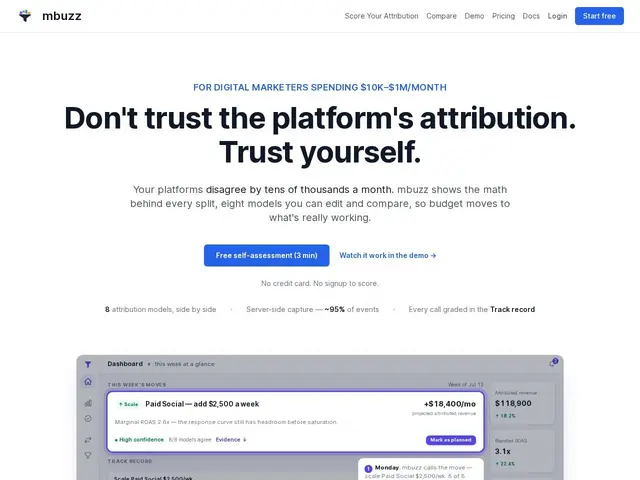
Description
Every ad platform loves to tell you its own campaigns drove the sale — Facebook takes credit, Google takes credit, and if you added them up you'd think you made triple your actual revenue. mbuzz cuts through that by tracking the real customer journey server-side and reconciling what platforms report against what actually landed in your bank account.
Built for technical marketers spending $20k-1m/month on paid acquisition, mbuzz runs eight attribution models side by side (rather than forcing you into one) through an Attribution DSL for custom modeling, with server-side tracking that avoids ad-blocker blind spots and supports first-party cookies. Open-source SDKs cover Node.js, Python, PHP, Ruby, plus adapters for Shopify, WooCommerce, WordPress, Laravel, Symfony and Rails. Pricing is event-based: a free tier, then Starter ($29/mo), Growth ($99/mo), and Pro ($299/mo), with no contracts.
💬 Our review
The short version: mbuzz is a solid pick for technical marketing teams tired of platform-reported ROAS not matching real revenue — the bank reconciliation angle is a genuinely useful differentiator most attribution tools don't offer.
Established players like Triple Whale or Northbeam dominate e-commerce attribution with polished dashboards and bigger sales teams behind them, but they lean toward marketing-only metrics rather than reconciling against actual bank data, and they typically cost more at scale. mbuzz's open-source SDKs and framework-level adapters (Laravel, Rails, Symfony) also make it a better fit if your team is comfortable integrating attribution at the code level rather than just installing a pixel. If you're already happy with your current attribution tool's numbers, there's no urgent reason to switch — but if you suspect your reported ROAS is inflated, mbuzz's free tier is worth testing.
💰 Pricing
📊 Global score
🤖 AI-enriched data
Palier gratuit disponible ; Starter 29$/mois ; Growth 99$/mois ; Pro 299$/mois. Facturation basée sur le volume d'événements, dépassements transparents, résiliable à tout moment.
Pros
Réconcilie le ROAS déclaré par les plateformes pubs avec les vraies données bancaires
8 modèles d'attribution disponibles simultanément, plus un DSL pour du sur-mesure
SDKs open source (Node, Python, PHP, Ruby) et adaptateurs frameworks (Laravel, Rails, Symfony)
Tracking côté serveur, résiste aux bloqueurs de pub
Cons
Moins de tableaux de bord prêts à l'emploi que les leaders e-commerce (Triple Whale, Northbeam)
Approche plus technique, demande des compétences d'intégration côté code
Produit jeune (fondé 2025), écosystème encore réduit
Facturation à l'événement peut devenir coûteuse à très gros volume