Stoa Markets
Stoa Markets is a B2B marketplace where AI labs, cloud providers, and enterprises source GPUs from verified sellers through structured quote requests instead of scattered broker networks.
🔗 Visit Stoa Markets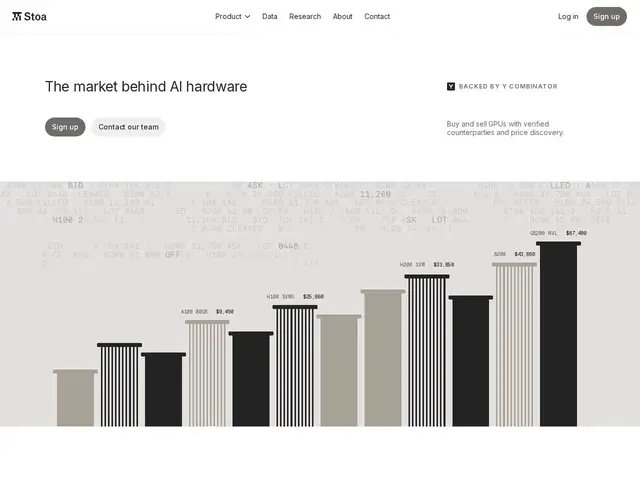
Description
Buying serious amounts of GPU hardware isn't like ordering from a normal e-commerce catalog — it usually means chasing down brokers, resellers, and OEMs one by one, comparing informal quotes, and hoping the seller is actually legitimate and has real stock. Stoa Markets is built to fix that by putting buyers and verified sellers in one place, so sourcing a batch of GPUs looks more like a structured RFQ (request for quote) process than a string of cold emails and DMs.
Technically, Stoa is an institutional B2B marketplace connecting AI labs, cloud providers, and enterprises with OEMs, brokers, resellers, and data center operators, using AI-assisted tools to help buyers submit RFQs and receive firm, comparable quotes. It monetizes through transaction fees on completed deals rather than subscriptions, and markets itself on the cost savings that come from price transparency and competition between sellers — the company cites a $156k savings example on its site. It's a Y Combinator S26 company, and its target users are explicitly institutional (AI labs, capital partners, system integrators) rather than individual developers renting compute.
💬 Our review
The short version: if your organization is procuring GPU hardware at real volume — not renting compute by the hour, but actually buying cards or systems — Stoa is worth a look because it replaces an opaque, relationship-driven broker process with structured, comparable quotes from vetted sellers, which is where the savings claim comes from.
The honest caveat is that this isn't a fit for individual developers or small teams that just need GPU compute — for that, hourly rental platforms like Vast.ai, RunPod, or Lambda Labs are the right comparison, not Stoa. Since Stoa is transaction-fee based and doesn't publish its commission structure, it's worth getting a clear number on total cost before assuming the advertised savings apply to your specific deal size, and as a young YC-backed marketplace it's still building out its network of verified sellers compared to established hardware brokers with decades of relationships.
💰 Pricing
📊 Global score
🤖 AI-enriched data
Taux de commission non communiqué publiquement, prélevé sur les transactions conclues. Argument commercial : économies via transparence des prix (exemple cité : 156k$ d'économies).
Pros
Process RFQ structuré remplace le sourcing informel par courtiers/emails
Vendeurs vérifiés (OEM, brokers, opérateurs data center)
Économies mises en avant via mise en concurrence et transparence des prix
Assistance IA pour la soumission de demandes de devis
Cons
Ne s'adresse pas aux développeurs individuels ou petites équipes (achat, pas location horaire)
Structure de commission non publiée
Réseau de vendeurs encore jeune (YC S26) face à des courtiers établis de longue date