Speko
Speko is a single API that routes your speech-to-text, text-to-speech, and speech-to-speech requests to whichever underlying AI model performs best for the language and use case.
🔗 Visit Speko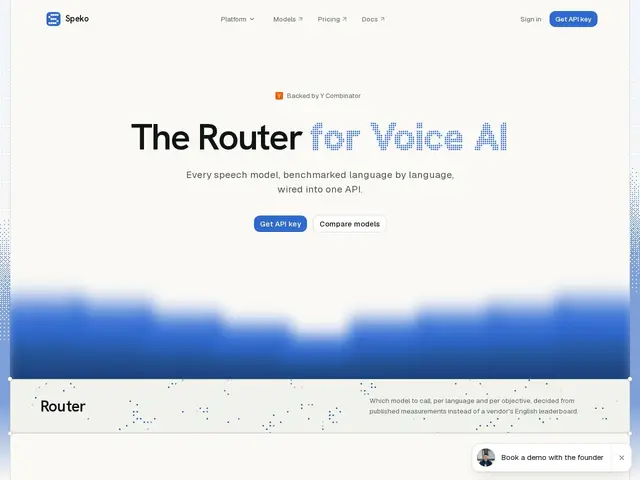
Description
Building a voice product usually means picking one speech AI vendor and living with its strengths and weaknesses everywhere — great English transcription but weak Mandarin, say, or natural-sounding English voices but robotic French ones. Speko sits in front of all the major voice AI providers and automatically sends each request to whichever model actually performs best for that language and task, so you get one integration instead of juggling several vendor accounts and SDKs.
Technically, Speko is an OpenAI API-compatible gateway covering speech-to-text, text-to-speech, and speech-to-speech, routing across providers like OpenAI, Google, Deepgram, ElevenLabs, and Alibaba's Qwen based on published performance benchmarks per language. It supports 9+ languages, is SOC 2 Type II, HIPAA, and GDPR compliant, and integrates with voice-agent frameworks like LiveKit and Pipecat as well as MCP-based coding tools. Pricing is usage-based, running roughly $0.001–$0.017 per minute depending on which underlying model gets used for a given request. It's a Y Combinator S26 company.
💬 Our review
The short version: if you're building a voice AI product that needs to work well across multiple languages, Speko saves you from either committing to one vendor's weak spots or building your own routing logic between providers — you integrate once, OpenAI-compatible, and it picks the best model per request automatically. The compliance certifications (SOC 2, HIPAA, GDPR) also make it a more plausible option for regulated use cases than piecing together raw provider APIs yourself.
The honest caveat is that per-minute pricing through a router can end up more expensive than negotiating direct volume pricing with a single provider once you're at real scale, and you're trusting Speko's benchmark methodology to actually reflect quality for your specific use case rather than doing that evaluation yourself. It's also a young YC S26 company, so as with any routing layer, going direct to a provider like Deepgram or ElevenLabs remains the lower-risk, more battle-tested option if you only ever need one language done extremely well.
💰 Pricing
📊 Global score
🤖 AI-enriched data
Facturation à l'usage, environ 0,001$ à 0,017$ par minute selon le modèle sous-jacent utilisé. Clé API requise.
Pros
Une seule intégration compatible API OpenAI pour plusieurs fournisseurs voix
Routage automatique vers le meilleur modèle par langue/tâche
Conformité SOC 2 Type II, HIPAA, RGPD
Intégrations frameworks vocaux (LiveKit, Pipecat) et MCP
Cons
Le prix à la minute via routeur peut coûter plus cher qu'un accord volume direct chez un seul fournisseur
Dépend de la méthodologie de benchmark de Speko plutôt que d'une évaluation propre
Startup jeune (YC S26) face à des fournisseurs directs très établis