Hoplite
Hoplite is a cloud platform where AI agents take a task from spec to a tested, reviewable pull request in an isolated sandbox, with GitHub integration built in.
🔗 Visit Hoplite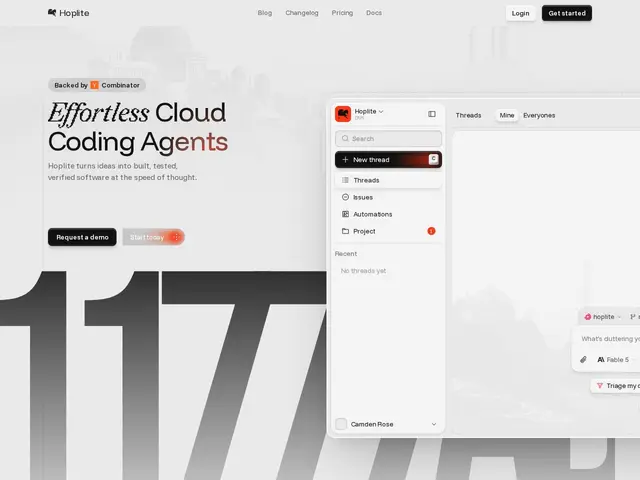
Description
Handing a coding task to an AI agent is one thing; trusting the result enough to merge it is another. Hoplite is built around that second part — instead of just generating code and hoping it works, it runs the whole task end-to-end in an isolated cloud environment: writing the code, running the actual test suite, and only then opening a pull request for a human to review and approve.
Technically, Hoplite connects to GitHub via OAuth and spins up isolated sandboxes per task, so agent work doesn't touch your local machine or a shared environment. It includes browser automation so agents can preview and interact with running apps (useful for frontend changes), an approval workflow for sensitive actions, MCP server integration, and CLI tooling for triggering and managing tasks. Pricing is tiered subscriptions based on sandbox capacity, with exact numbers on its pricing page. It's a Y Combinator S26 company.
💬 Our review
The short version: if you want an AI coding agent that doesn't just spit out a diff but actually runs your tests and gives you a real, verified pull request to review, Hoplite's isolated-sandbox-plus-GitHub-workflow approach is a genuinely useful shape for teams that are cautious about trusting agent output directly.
The honest caveat is that it's a young YC S26 product competing in a crowded field — Devin, GitHub Codespaces (with Copilot workspace features), and Cursor's background agents all offer overlapping capabilities, and Hoplite's isolated-sandbox-per-task model likely costs more per task than a lighter-weight in-editor agent, which is the trade-off you're paying for the verification and isolation. Exact pricing isn't in the raw facts here, so check the live pricing page for current sandbox-tier costs before committing a team to it.
💰 Pricing
📊 Global score
🤖 AI-enriched data
Plans à paliers selon la capacité de sandboxes, détails sur la page pricing officielle.
Pros
Exécute la tâche de bout en bout : code, tests réels, puis pull request
Sandboxes isolées par tâche, intégration GitHub via OAuth
Automatisation navigateur pour prévisualiser les changements frontend
Workflow d'approbation pour les actions sensibles
Cons
Marché très concurrentiel (Devin, Cursor, GitHub Codespaces)
Coût par tâche probablement supérieur à un agent léger dans l'éditeur
Produit jeune (YC S26), tarification précise à vérifier sur place