OneMCP
OneMCP merges all of your MCP servers behind a single endpoint so an AI agent can reach every tool through just three simple commands instead of hundreds.
🔗 Visit OneMCP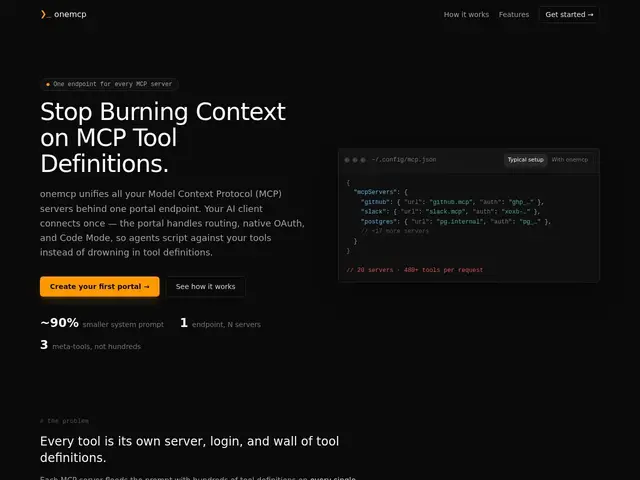
Description
MCP (Model Context Protocol) is a standard that lets an AI assistant connect to your tools — GitHub, Slack, your database — without custom code for each one. The problem is that as soon as you connect more than a handful of these tools to an AI agent, things get messy: every tool floods the agent's instructions with its own list of commands, like handing someone a pile of remote controls, one for each device in the house. OneMCP is the universal remote — it sits in front of all your MCP servers and gives the AI agent a single, tidy entry point to reach every one of them.
Technically, OneMCP consolidates any number of MCP servers behind one endpoint and exposes just three meta-tools — search, describe, and execute — instead of forcing the agent to load hundreds of individual tool definitions into its system prompt. Agents call search to find the right tool across all connected servers, describe to learn how to use it, and execute to run it, which OneMCP reports cuts system prompt bloat by roughly 90% and keeps agents faster and cheaper to run as more integrations are added.
💬 Our review
The short version: OneMCP is a smart idea — a single gateway that hides the complexity of running many MCP servers behind three simple meta-tools — but it's a young, unproven product with no public pricing, so treat it as a bet on execution rather than a safe default.
Compared to Smithery and MCP.so, which are primarily directories that help you discover and list MCP servers, OneMCP does something different: it actually consolidates those servers behind one live endpoint your agent talks to, rather than just pointing you to where to find them. Composio is the more direct competitor and the safer choice today — it's more established, covers a much wider range of integrations, and has a track record with production teams. OneMCP's pitch (fewer tokens, one endpoint, less prompt bloat) is compelling on paper, but with no pricing published anywhere and details locked behind a login at app.onemcp.dev, it's impossible to judge value for money before you sign up. That opacity is the single biggest reason to hesitate.
💰 Pricing
📊 Global score
🤖 AI-enriched data
Aucune grille tarifaire publique. La création d'un portail se fait via app.onemcp.dev ; modèle probablement freemium ou par abonnement, mais les détails ne sont visibles qu'après connexion.
Pros
Point d'entrée unique pour n'importe quel nombre de serveurs MCP
Trois meta-tools (search, describe, execute) au lieu de centaines de définitions d'outils
Réduction annoncée d'environ 90% du prompt système
Facilite le passage à l'échelle : ajouter un serveur MCP ne surcharge pas l'agent
Cons
Aucune tarification publique, détails accessibles seulement après connexion
Produit jeune et peu éprouvé face à des acteurs plus établis comme Composio
Ajoute une dépendance : l'accès aux outils passe désormais par l'endpoint OneMCP