KanaSensei
A free web app that helps English speakers learn to read Japanese hiragana and katakana in about two weeks using spaced repetition drills.
🔗 Visit KanaSensei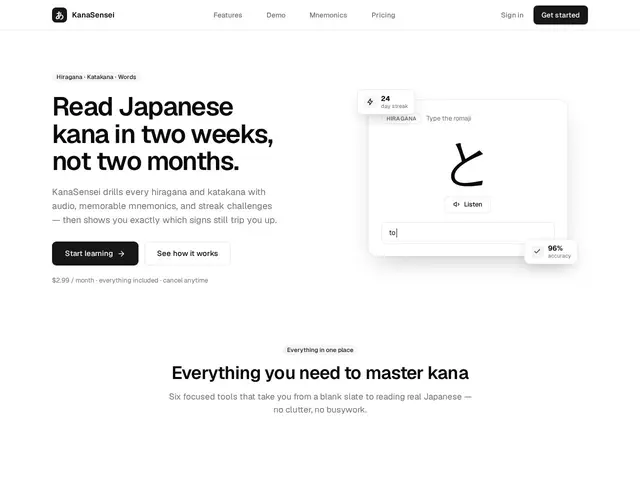
Description
KanaSensei is a simple website that helps English speakers learn to read the two basic Japanese alphabets, hiragana and katakana, known together as kana. These are the phonetic building blocks of the Japanese writing system that you need to know before tackling kanji (the more complex Chinese-derived characters) or reading full Japanese sentences. Instead of throwing a whole language at you at once, KanaSensei focuses narrowly on getting you reading kana fluently, with many learners reporting they can do so in about two weeks of daily practice.
Under the hood, KanaSensei relies on a spaced repetition system (SRS) similar to flashcard tools like Anki: characters you get wrong are shown to you more frequently, while ones you consistently answer correctly are spaced further apart, reinforcing long-term retention rather than short-term cramming. The learning path is structured into small, sequential drill sets that introduce a handful of kana at a time, layering in review rounds so earlier characters resurface as new ones are added, rather than dumping the full 46+46 character set on the learner from day one.
💬 Our review
The short version: KanaSensei is a tight, free tool that does one job well — get you reading hiragana and katakana fast — and it doesn't try to be anything more.
Compared to WaniKani, which is the most popular alternative for this kind of drilling, KanaSensei is much narrower in scope: WaniKani eventually takes you through thousands of kanji and vocabulary using the same SRS philosophy, but it's a paid subscription and kana is really just its warm-up phase. If your goal is only to read kana, WaniKani is overkill and costs money for a job KanaSensei does for free. Compared to Anki, the trade-off flips: Anki is free and infinitely flexible, but it's just an engine — you (or the community) have to build or download the actual kana deck yourself, and there's no purpose-built course structure guiding you through it. KanaSensei sits in between: less flexible than Anki, less ambitious than WaniKani, but zero cost and zero setup.
On price/value, this is close to a no-brainer if kana is genuinely your bottleneck: it's free, single-purpose, and gets out of your way once you're done, which is exactly what a narrow two-week task needs. Just don't expect it to carry you into kanji or conversation — you'll need another tool (WaniKani, Anki, or a full course like Renshuu) for that next stage.
💰 Pricing
📊 Global score
🤖 AI-enriched data
Application web gratuite ; aucune offre payante ni abonnement détecté lors de l'analyse initiale.
Pros
Gratuit et sans complexité d'inscription
Se concentre uniquement sur les kana, sans surcharge d'apprentissage
Méthode de répétition espacée éprouvée pour la mémorisation
Objectif clair et atteignable en environ deux semaines
Cons
Ne couvre ni les kanji ni le vocabulaire
Peu d'informations publiques sur la structure exacte du parcours
Communauté et ressources annexes plus limitées que WaniKani ou Anki