Agent Armor
A free, open-source security layer that scans everything going into and out of an AI agent — user input, retrieved documents, model output — for prompt injection, hidden instructions, and data-leak attempts before they can do damage.
🔗 Visit Agent Armor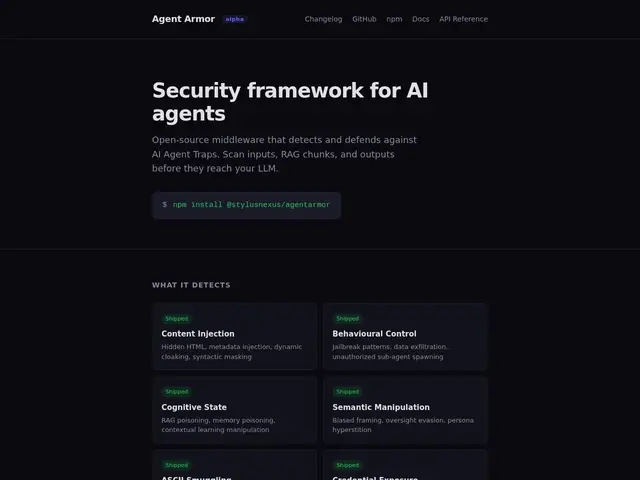
Description
Giving an AI agent the ability to browse, read documents, and take actions also opens it up to a whole new category of attacks: a webpage with hidden text instructing the agent to leak data, a poisoned document in a RAG pipeline, or a jailbreak buried in Unicode characters a human reviewer would never notice. Agent Armor is built specifically to catch these — it wraps an agent with eight independent security layers covering ingestion, storage, context, planning, execution, output, inter-agent communication, and identity.
It's built on Google DeepMind's AI Agent Traps taxonomy and checks for content injection (hidden HTML, metadata cloaking), behavioral manipulation (jailbreak patterns, exfiltration pathways), and semantic tricks like ASCII smuggling and Unicode steganography. The project reports an 88.9% detection rate with 0% false positives across its curated test set, and ships as an installable npm package for straightforward integration into an existing agent stack.
💬 Our review
The short version: if you're deploying an AI agent that reads untrusted content (web pages, documents, third-party data) or takes real actions, Agent Armor is a free, open-source way to add a checked security layer rather than shipping with no defense against prompt injection at all.
Against doing nothing — which is still the default for a lot of agent deployments — Agent Armor's eight-layer coverage and grounding in a published attack taxonomy (DeepMind's AI Agent Traps) is a meaningful, no-cost upgrade. Compared to dedicated commercial guardrail products like Lakera Guard or open frameworks like NeMo Guardrails, it's a younger, narrower project (built by an individual maintainer, MIT licensed) rather than a vendor-backed platform with SLAs — a reasonable choice for teams that want free, inspectable protection and are comfortable evaluating an open-source security tool on its own merits rather than leaning on a paid vendor's support.
💰 Pricing
📊 Global score
🤖 AI-enriched data
Gratuit et open-source (licence MIT)
Pros
8 couches de défense couvrant tout le pipeline de l'agent
Basé sur la taxonomie AI Agent Traps de Google DeepMind
88.9% de détection avec 0% de faux positifs rapportés
Gratuit, open-source, installable en package npm
Cons
Projet jeune, maintenu par un individu, pas une équipe vendor
Pas de support commercial/SLA contrairement aux solutions payantes
Détection basée sur des patterns — pas une garantie absolue contre toute attaque nouvelle