FetchSandbox
Lets an AI coding agent (or a developer) test that a Stripe webhook, a GitHub API call, or a Twilio integration actually works — against a realistic fake version of that API — instead of burning real quota or waiting for a staging environment.
🔗 Visit FetchSandbox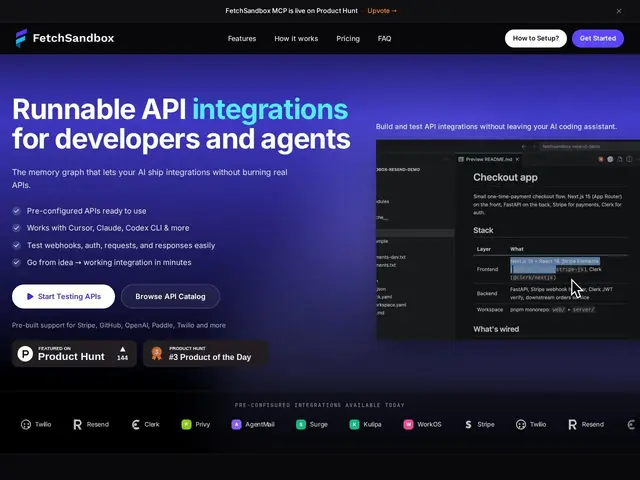
Description
When an AI coding agent writes code that calls Stripe or sends a GitHub webhook, there's no easy way for it to know the integration actually works — it either has to use real API credentials (burning quota, risking real side effects) or you have to manually verify it yourself later, often after it's already shipped. FetchSandbox exists to close that gap by giving both AI agents and developers a realistic fake version of 60+ real-world APIs to test against.
It plugs directly into IDEs and AI coding tools (Cursor, Claude Code, Windsurf, VS Code, Codex) via MCP, so an agent can ingest an API spec, list out the workflows it exposes, and actually run them — including edge cases like webhooks, retries, async state changes and failure scenarios — without touching a real Stripe or Twilio account. Every run gets a shareable receipt URL, so a fix can be verified and shown to a teammate rather than just claimed to work. It's had real early traction — thousands of monthly visitors and npm downloads, and a top-3 Product of the Day finish on Product Hunt.
💬 Our review
The short version: if you're using an AI coding agent to build integrations with Stripe, GitHub, Twilio or similar APIs, FetchSandbox gives that agent a safe, realistic sandbox to actually verify its own work instead of you finding out it's broken in production.
Against general-purpose mocking tools like WireMock or Postman's mock servers, FetchSandbox's edge is being purpose-built for the AI-agent workflow via MCP — an agent can discover and run test scenarios itself rather than a human hand-configuring mocks. The free tier (1,000 runs/month) is generous enough for individual developers and small projects; the $5/month Pro tier for 10,000 runs is cheap insurance against shipping a broken integration. The tradeoff is coverage — 60+ APIs is a solid start but won't include every service you might integrate with, so for something outside that list you're back to a general mocking tool.
💰 Pricing
📊 Global score
🤖 AI-enriched data
Gratuit (1000 runs/mois) · Pro $5/mois (10 000 runs) · Enterprise sur devis
Pros
60+ API réalistes simulées (Stripe, GitHub, OpenAI, Twilio, Clerk...)
Intégration MCP native pour agents IA (Cursor, Claude Code, Windsurf)
Simule webhooks, retries et scénarios d'échec, pas juste des réponses statiques
URLs de reçu partageables pour prouver qu'un fix fonctionne
Cons
Couverture limitée à 60+ API — pas universel comme un mock générique
Nécessite Node.js 18+ et une configuration MCP manuelle initiale
Facturation au 'run' plutôt qu'à l'appel API, à bien comprendre avant de scaler
Produit encore jeune malgré une bonne traction initiale