Kontexta
A free, open-source local memory system for AI coding assistants — so Claude Code, Cursor and other agents remember your project's decisions and history instead of starting from zero every session.
🔗 Visit Kontexta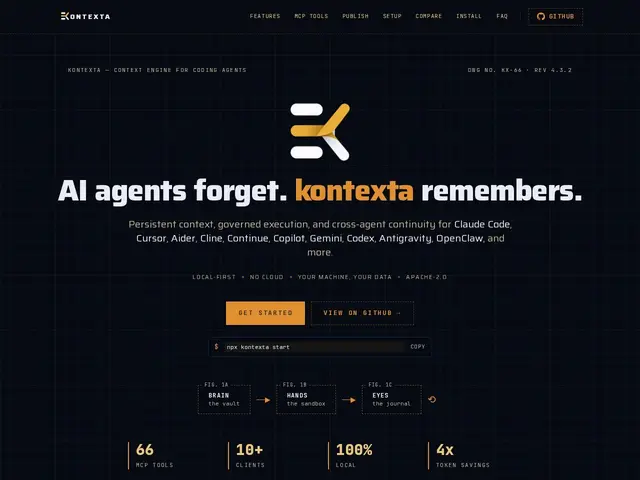
Description
AI coding assistants are impressively capable within a single conversation, then forget everything the moment it ends. Ask Claude Code to fix a bug today and Cursor to continue tomorrow, and neither knows what the other one learned — you end up re-explaining architecture decisions and past debugging context over and over, or stuffing a giant context file into every prompt and burning tokens on things the agent doesn't actually need right now.
Kontexta is an open-source, local-first fix for that: a persistent vault (built on a searchable markdown store) that different AI agents can read from and write to, so a decision Claude Code journals today is available to Cursor tomorrow. Instead of dumping the whole history into every prompt, it surgically fetches only the relevant piece — the project maintainers claim roughly 73% lower token usage as a result. It runs entirely on your machine (no cloud, no account, install via a single npx command), supports over ten different AI coding tools, and can optionally sync your vault to a private git remote if you want it backed up or shared across machines.
💬 Our review
The short version: if you bounce between multiple AI coding agents (Claude Code, Cursor, Copilot) on the same project and you're tired of re-explaining context every session, Kontexta gives them a shared, local memory for free.
Compared to tools like claude-mem that focus on a single agent's session history, Kontexta's differentiator is being explicitly cross-agent and local-first — no cloud account, no vendor lock-in, and it's Apache-2.0 licensed so you can inspect or modify it. The tradeoff is that it's a newer, community-maintained project rather than an officially blessed feature of any single AI tool vendor, so expect some rough edges and a smaller support surface than a first-party memory feature would have. For solo developers or small teams juggling more than one AI coding tool on the same codebase, it's a genuinely useful, zero-cost addition; if you only ever use one agent, a lighter single-agent memory tool may be simpler.
💰 Pricing
📊 Global score
🤖 AI-enriched data
Apache-2.0, gratuit, auto-hébergé (npx ou Docker), aucun palier payant
Pros
Mémoire partagée entre 10+ agents IA (Claude Code, Cursor, Gemini, Copilot...)
100% local-first, aucun cloud ni compte requis
Open-source (Apache-2.0), inspectable et modifiable
Réduction de tokens revendiquée (~73%) via lecture ciblée plutôt que contexte massif
Cons
Projet communautaire jeune, pas un outil officiel d'un éditeur
Setup et configuration à la charge du développeur
Moins de support qu'une fonctionnalité mémoire native d'un seul outil
Utile surtout si on utilise réellement plusieurs agents en parallèle