Epho
A cloud API that runs AI coding agents (Claude Code, Codex, OpenCode) on demand in isolated sandboxes, billed by the second, so you don't have to host the infrastructure yourself.
🔗 Visit Epho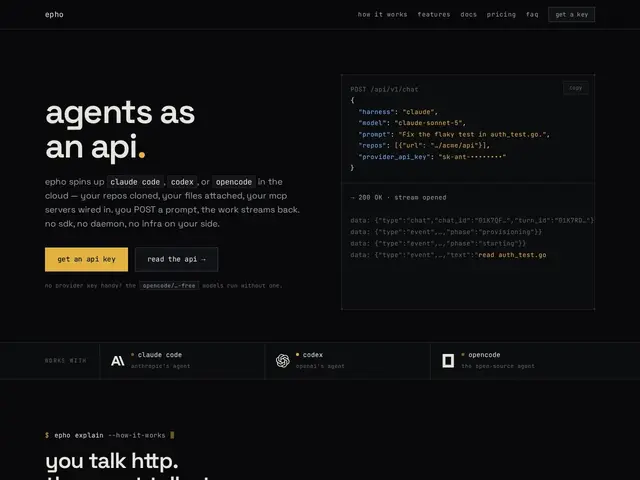
Description
If you want to let an AI coding agent work on a repository — running tests, fixing a bug, generating a PR — you normally have to either run it on your own machine or set up and maintain cloud infrastructure to run it safely at scale. Epho skips that setup: you send one HTTP request with a prompt and your repo, and it spins up an isolated cloud sandbox, runs the agent of your choice, and streams the results back — no servers, containers, or SDKs to manage on your end.
Epho exposes a single POST endpoint that launches Claude Code, Codex, or OpenCode inside an isolated sandbox, with support for up to 32 repositories and 20 input files per request, MCP server integration, and results delivered via event streaming or webhook. Sessions are resumable: passing the same chat_id back lets the sandbox continue with the same filesystem and checkout, and if the underlying machine is gone, Epho restores it from a snapshot so the session survives. Billing is metered per second (CPU, memory, and disk), with model token usage billed separately by the provider you choose.
💬 Our review
The short version: Epho is infrastructure, not a product you'd point a non-technical user at — it's for engineering teams who want to run AI coding agents at scale without building and maintaining the sandboxing themselves, and the per-second billing means costs scale with actual usage rather than a flat subscription.
Against E2B, the closest comparable (cloud sandboxes purpose-built for AI agent code execution), Epho's differentiator is coming pre-wired specifically for coding-agent harnesses (Claude Code, Codex, OpenCode) rather than being a general-purpose sandbox you configure yourself. Against just using GitHub Codespaces or a self-managed Docker fleet, Epho trades control for convenience: one API call versus building your own orchestration, session persistence, and snapshotting. The $10 starting credit (~60 hours of default-instance runtime) is enough to validate the fit before committing, but this is squarely a build-on-top-of tool for developers, not a turnkey app. <!-- ai-generated -->
💰 Pricing
📊 Global score
🤖 AI-enriched data
$10 de crédit offert (~60h d'instance par défaut) ; puis CPU/RAM/disque facturés à la seconde ; tokens modèle facturés à part
Pros
Un seul appel API pour lancer un agent de code isolé
Sessions reprenables avec snapshot automatique
Facturation à l'usage, pas d'abonnement fixe
Cons
Outil d'infrastructure pur, demande de l'intégration
Coûts moins prévisibles qu'un abonnement forfaitaire