Defakto
A security tool for the passwords nobody thinks about — not the ones humans type, but the ones baked into scripts, servers and automated jobs that quietly run forever with the same credentials, which is exactly what attackers look for.
🔗 Visit Defakto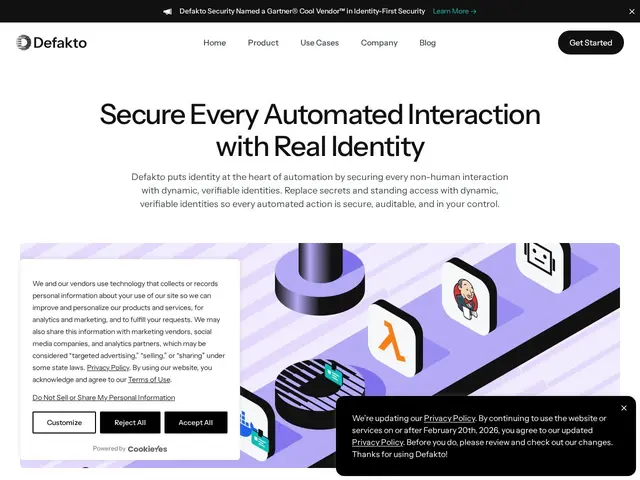
Description
Every company has thousands of "non-human" logins — a deployment script, a background job, a server talking to a database — each one usually protected by a password or API key that gets created once and then never changes, sometimes for years. Those long-lived, hardcoded credentials are one of the most common ways real breaches happen, because once one leaks, it keeps working until someone notices. Defakto exists to replace that pattern with identities that are issued fresh at runtime and expire quickly, so a leaked credential is useless within minutes instead of indefinitely.
Defakto discovers, issues, enforces and governs non-human identities (services, jobs, machines, AI agents) across cloud, hybrid and on-premises infrastructure, built on the open SPIFFE standard rather than a proprietary protocol. It integrates with AWS, Azure, GCP, Kubernetes, GitHub Actions, GitLab and Jenkins, gives real-time audit and policy enforcement, and actively finds orphaned service accounts that nobody remembers creating. The company (formerly SPIRL) raised a $30.75M Series B and was named a Gartner Cool Vendor in Identity-First Security for 2025.
💬 Our review
The short version: as companies automate more (CI/CD pipelines, background jobs, and now AI agents), the number of non-human logins is exploding faster than anyone can track manually — Defakto's pitch is to replace static, forever credentials with short-lived ones issued automatically, which directly closes one of the most common real-world breach vectors.
Building on SPIFFE (an open, vendor-neutral standard) rather than a proprietary protocol is a meaningfully good decision — it avoids locking a security-critical layer of infrastructure into one vendor's format. Case studies claiming an 80% reduction in credential management overhead are a strong number, though as with most enterprise security tools, real savings depend heavily on how messy your existing credential sprawl already is. Pricing is entirely unpublished, which is standard for this category (Fortune 500-focused identity infrastructure) but means real cost comparison against competitors requires a sales conversation either way.
💰 Pricing
📊 Global score
🤖 AI-enriched data
Aucune grille tarifaire publique — positionnement entreprise, devis sur mesure requis.
Pros
Basé sur le standard ouvert SPIFFE plutôt qu'un protocole propriétaire — pas de verrouillage fournisseur
Identités à courte durée de vie émises au runtime plutôt que credentials statiques permanents
Reconnu Gartner Cool Vendor 2025 en sécurité des identités
Détection active de comptes de service orphelins oubliés
Cons
Tarification totalement opaque, aucune comparaison possible sans contact commercial
Positionnement très entreprise (Fortune 500) — probablement disproportionné pour une petite équipe
Nécessite une infrastructure déjà structurée (Kubernetes, CI/CD) pour tirer pleinement parti de l'outil