CodeIntegrity
A security layer for companies that let AI agents take real actions on their behalf (booking things, editing databases, sending messages) — it steps in at the exact moment an agent is about to act and checks whether that action is actually safe to run, in
🔗 Visit CodeIntegrity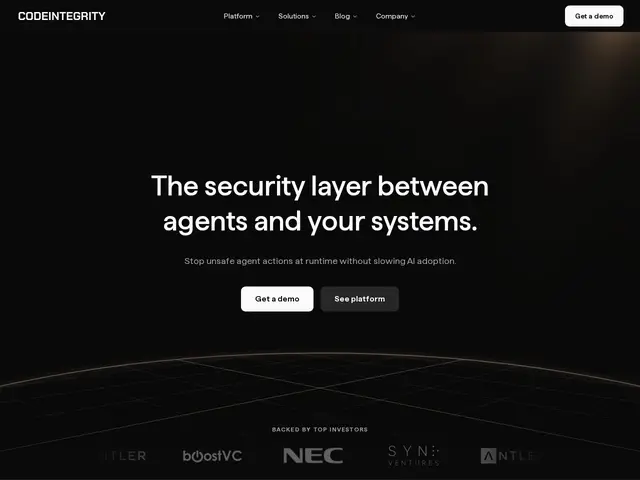
Description
Regular software always does the same thing for the same input, which is why it's possible to test and trust it. AI agents don't work that way — the same prompt can lead to a different action depending on subtle context, and a cleverly worded message (a "prompt injection") can trick an agent into doing something it was never meant to do, like leaking data or taking a destructive action. CodeIntegrity exists to put a deterministic safety layer in front of that unpredictability, checking every agent action against strict rules before it's allowed to execute.
CodeIntegrity builds runtime security controls for autonomous AI agents in production, enforcing security boundaries at the exact point of decision so an agent can't take an unsafe or unintended action even if it's been manipulated by a prompt injection. The team got attention for publicly demonstrating how easy it was to trick AI agents from several major vendors into leaking private information — including compromising the Notion note-taking app in under four hours, a stunt covered by The Economist — which is effectively their own proof of the problem they're now selling the fix for.
💬 Our review
The short version: CodeIntegrity is a bet that as companies give AI agents more autonomy (letting them actually do things, not just answer questions), a dedicated runtime security layer becomes as necessary as a firewall — and their public prompt-injection demos are a credible way to make that case.
At $5M seed and founded in 2024, this is an early-stage product without a public price sheet, so any adoption starts with a sales conversation and likely a pilot. The core value proposition — deterministic, rule-based guardrails around inherently non-deterministic AI agents — is sound in principle, but so is every competing AI-agent-security startup's pitch right now (Alter, CodeIntegrity's own category is getting crowded fast in 2026). The differentiator worth testing for yourself is whether the runtime controls actually catch injection attempts your own red-team tries, not just the marketing demo.
💰 Pricing
📊 Global score
🤖 AI-enriched data
Aucune grille tarifaire publique — startup en phase seed ($5M levés en 2026), contact commercial requis. Site protégé contre l'accès automatisé (HTTP 403), cohérent avec son propre positionnement sécurité.
Pros
Contrôles runtime déterministes appliqués au moment précis de la décision de l'agent
Équipe crédible : a publiquement démontré une compromission de Notion en moins de 4h (couvert par The Economist)
Levée de fonds ($5M seed, Syn Ventures + Antler + Boost VC) validée par des investisseurs spécialisés cybersécurité
Positionnement clair sur un problème réel et grandissant (agents IA autonomes en production)
Cons
Tarification totalement opaque — impossible de comparer le coût sans contact commercial
Startup jeune (fondée 2024), peu de recul client public disponible
Catégorie "sécurité des agents IA" en train de se remplir vite (Alter, Obsidian et d'autres YC récents) — différenciation à vérifier soi-même plutôt qu'à prendre pour acquis