TraceLLM
An observability tool that traces prompts, spans, tokens, errors and model calls once your AI app is in production.
🔗 Visit TraceLLM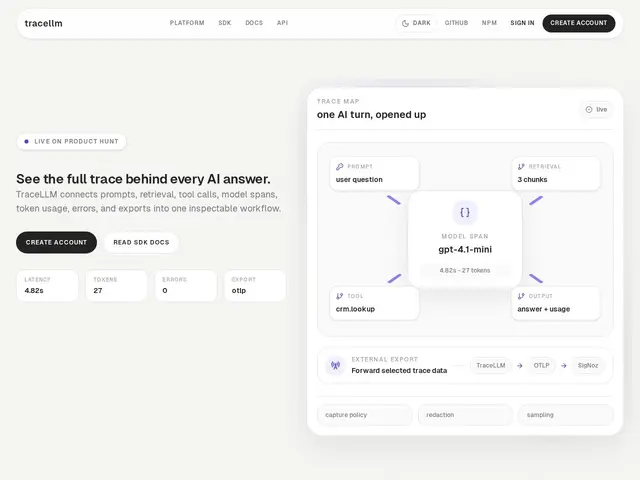
Description
An AI app that works perfectly in a demo can go quiet and confusing the moment it hits real production traffic: which prompt caused the weird answer, how many tokens did that one request actually burn, where did the chain of calls slow down? TraceLLM exists to answer those questions instead of leaving you to grep through logs.
TraceLLM is an observability platform purpose-built for LLM-powered applications: it records sessions, spans, events, errors, token usage, latency and metadata across chatbots, agents, RAG pipelines, model routers and custom AI workflows, then surfaces them as a single trace timeline per workflow. It optionally captures prompt and output content for deeper debugging, exports traces via OpenTelemetry (OTLP) with explicit SigNoz integration, and exposes a documented REST API (Swagger/OpenAPI) plus a Node.js SDK for instrumenting an app directly. It's built and maintained by a solo developer, MIT-licensed, with authentication handled via Argon2id-hashed email/password accounts.
💬 Our review
The short version: TraceLLM does the unglamorous but necessary job of giving you a single trace timeline — sessions, spans, events, errors, tokens, latency — across chatbots, agents, RAG pipelines and model routers, with OpenTelemetry/OTLP export so it can plug into observability stacks you may already run (SigNoz is explicitly supported).
It's a solo-developer, MIT-licensed project, which is exactly the trade-off it looks like: cheap or free to try and easy to audit the code, but with none of the SLA, support team, or roadmap certainty of a funded observability vendor. Pricing isn't published, which for a self-hosted-friendly, OTLP-based tool often means "free/open-core for now" — worth confirming before depending on it for anything business-critical. Against a heavier commercial platform like Langfuse or Helicone, TraceLLM is lighter-weight and more DIY; if you already export OTLP data somewhere, it's a low-friction way to add LLM-specific tracing without adopting a whole new vendor relationship.
💰 Pricing
📊 Global score
🤖 AI-enriched data
Aucune grille tarifaire publiée sur le site. Projet solo, sous licence MIT, ce qui suggère un usage libre ou open-core à ce stade — à confirmer avant tout usage critique.
Pros
Timeline de trace unique : sessions, spans, événements, erreurs, tokens, latence
Export OpenTelemetry/OTLP, intégration SigNoz
API REST documentée (Swagger/OpenAPI) + SDK Node.js
Code source MIT, léger et auditable
Cons
Projet développé par une seule personne — pas de garantie de support ou de continuité
Tarification non publiée, statut commercial flou
SDK Node.js encore en package workspace, pas publié sur npm au moment de l'analyse
Projet jeune (dépôt créé fin 2024), moins mature qu'un outil financé