Octopus.do
Lets you draw out a website's whole structure — every page, how they link, and a rough sketch of each one — before anyone writes code, and can even generate that starting map for you from a prompt or an existing site.
🔗 Visit Octopus.do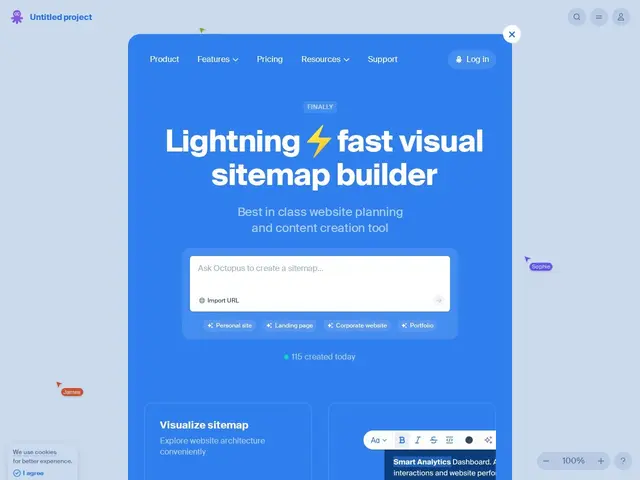
Description
Before a website gets built, someone has to decide what pages it needs and how they connect — and doing that in a spreadsheet or a Word doc makes it hard for a client or developer to actually picture the site. Octopus.do turns that planning step into a visual map: drag out pages, draw arrows between them to show navigation and user flows, and drop a rough lo-fi wireframe onto each page so people can see structure and content at a glance, not just a list of URLs.
It leans heavily on AI to speed up the blank-page problem — generate a full sitemap from a text prompt, crawl an existing website to reverse-engineer its structure automatically, get AI-suggested color palettes, and have AI draft or rewrite page copy with SEO meta tags included. Beyond planning, it can export to PNG, PDF, XML, CSV and Figma, plug into Webflow and WordPress, and even publish a sitemap as a live, browsable site. It's aimed at anyone touching the early stages of a website project — copywriters, SEO specialists, marketers, freelancers and UX designers — and lists past use by teams at Twitter, Meta and Amazon.
💬 Our review
The short version: Octopus.do is a mature, AI-accelerated take on an old idea — the visual sitemap — and it's differentiated less by the sitemap itself than by everything bolted onto it: AI copywriting, an existing-site crawler, and direct publishing.
The website crawler is genuinely useful for a specific case that competitors handle less directly: inheriting an existing site and needing to document or replan it fast, rather than starting from a blank canvas. The AI content generation (with SEO meta tags) pushes it past a pure planning tool into early content production, which can save a real step for small teams without a dedicated copywriter. Its closest comparison in this catalog is FlowMapp, which covers similar ground (sitemaps, user flows, wireframes) but leans more toward client-facing project management (cost estimates, invoices) — pick Octopus.do if AI generation and crawling an existing site matter more to you, FlowMapp if managing client proposals and project costs alongside the planning does. One gap: exact pricing tiers aren't easy to verify from the homepage itself, so budget-conscious teams should check the pricing page directly before committing.
💰 Pricing
📊 Global score
🤖 AI-enriched data
Palier gratuit disponible avec fonctionnalités limitées. Abonnements payants entre environ 8 $ et 96 $/mois selon la source, montants exacts non vérifiés directement sur la page d'accueil au moment du test.
Pros
Génération de sitemap par IA à partir d'un prompt
Crawler qui reconstruit automatiquement la structure d'un site existant
Génération de contenu et balises SEO par IA
Export vers Figma, Webflow, WordPress, PNG, PDF, XML, CSV
Cons
Grilles de prix exactes peu claires depuis la page d'accueil
Fonctionnalités IA dépendent de l'API OpenAI, pas de contrôle total sur le moteur
Chevauchement fonctionnel important avec FlowMapp