AllStak
Puts error tracking, logs, distributed tracing and infrastructure metrics in one dashboard instead of four separate subscriptions, aimed at teams that don't want to stitch together Sentry, a log tool and a metrics tool by hand.
🔗 Visit AllStak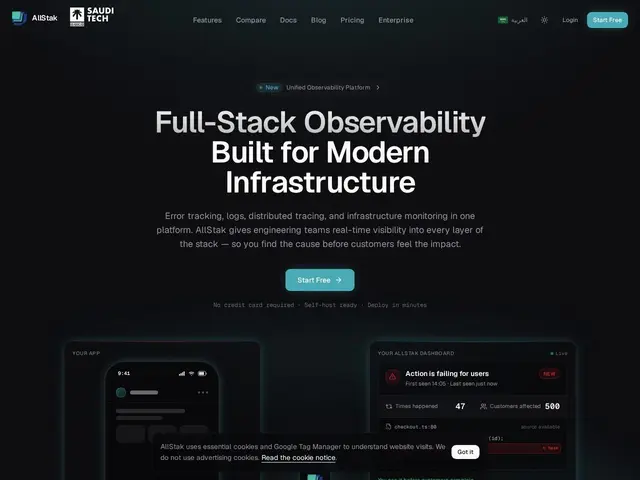
Description
Modern applications tend to accumulate a pile of separate monitoring tools over time — one for error tracking, another for logs, another for distributed tracing, another for server metrics — each with its own dashboard, login and bill. AllStak's pitch is to replace that pile with a single unified observability platform that covers all four at once, so an engineer investigating an incident doesn't have to jump between four tabs to piece together what happened.
It covers error tracking with automatic grouping and deduplication, distributed tracing across services, structured real-time log streaming, and infrastructure metrics like CPU and memory, tied together with an incident timeline that correlates all of it and alerts routed to Slack, PagerDuty, email or webhooks. It supports common stacks (JavaScript, React, Next.js, Node.js, Spring Boot, Docker) and is OpenTelemetry-compatible, so it can slot into an existing instrumentation setup rather than requiring a rewrite. The company behind it, Techsea, is based in Saudi Arabia and holds local data-protection certification, which may matter for teams with data-residency requirements in that region.
💬 Our review
The short version: AllStak is a consolidation play — it's betting that most teams would rather pay one bill and check one dashboard for errors, logs, traces and infra metrics than manage four separate tools, and it prices the free tier generously enough to actually test that.
The free tier (50K events/month, 3-day retention, one environment) is a real way to try it before paying, and the jump to Pro at $119/month for 5M events and 30-day retention undercuts a lot of dedicated observability platforms once you'd otherwise be paying for error tracking and log management separately. OpenTelemetry compatibility is the right call — it means adopting AllStak doesn't require ripping out existing instrumentation. The honest tradeoff of an all-in-one tool is depth: established single-purpose leaders like Sentry (errors) or Honeycomb (tracing) have had years to refine that one thing, and AllStak is unlikely to match either at their specialty yet, especially given it's a newer, less globally known product. It's worth trying if tool-sprawl and subscription fatigue are your bigger problem; if you need best-in-class tracing or error tracking specifically, a specialized tool will likely still outperform it.
💰 Pricing
📊 Global score
🤖 AI-enriched data
Free : 50K événements/mois, rétention 3 jours, 1 environnement — Pro : 119 $/mois facturé annuellement, 5M événements/mois, rétention 30 jours, environnements illimités — Enterprise : sur devis.
Pros
Consolide error tracking, logs, tracing et métriques infra en un seul dashboard
Compatible OpenTelemetry, s'intègre à l'instrumentation existante
Palier gratuit généreux (50K événements/mois) pour tester avant de payer
Prix Pro (119 $/mois) compétitif face à la somme de plusieurs outils spécialisés
Cons
Produit moins connu et moins éprouvé que les leaders spécialisés (Sentry, Honeycomb)
Probablement moins profond sur chaque fonction prise isolément qu'un outil dédié
Basé en Arabie Saoudite, moins de présence/reconnaissance internationale établie