Phinq
Sits between your AI agent and the outside world, catching risky actions — deleting a file, reading a credential, sending money — and holding them for a human to approve before they actually happen.
🔗 Visit Phinq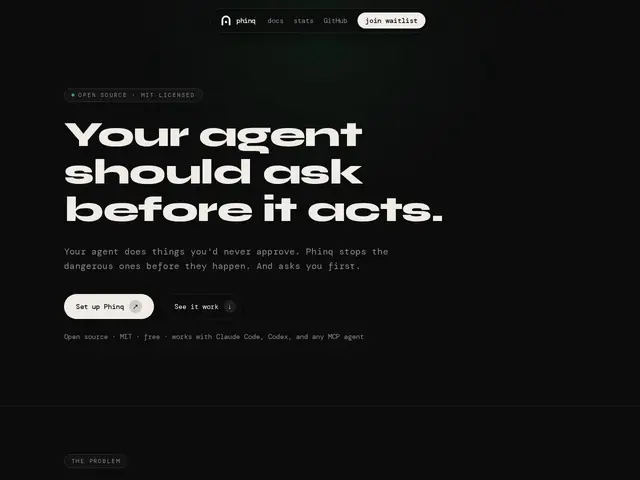
Description
Give an AI agent the ability to run code or call tools on your behalf, and it will eventually try to do something you didn't want — delete the wrong file, read a secret it shouldn't, send an email to the wrong list, or spend money without asking. Phinq is a safety layer that sits between the agent and the actions it's allowed to take: every tool call passes through it first, gets classified by risk, and anything irreversible or dangerous gets held for a human to approve before it executes.
It's open source (MIT license) and framework-agnostic — it works with Claude, OpenAI, Anthropic, LangChain, CrewAI, AutoGen and any MCP-based agent, and can be deployed as a proxy, an SDK, or an HTTP gate depending on your setup. Safe, reversible actions pass through with minimal added latency; risky ones (deletes, credential reads, payments, bulk sends) get held, and the system fails closed, meaning anything denied or left unanswered is blocked rather than allowed by default. It also keeps a tamper-evident, hash-chained audit log of every decision, which matters for teams that need to show a compliance trail for what their agents were and weren't allowed to do.
💬 Our review
The short version: as more teams let AI agents actually take actions instead of just answering questions, Phinq is a bet that "who approves the risky ones" needs to be infrastructure, not an afterthought — and it's free, open source, and works with whatever agent framework you're already using.
The fail-closed default and the hash-chained audit log are the two design choices that matter most here: a lot of homegrown "just add a confirmation step" approaches fail open when something goes wrong, and don't leave a trail a compliance team can actually check. Being MIT-licensed and framework-agnostic (proxy, SDK, or HTTP gate) removes the usual lock-in objection to adding a new piece of agent infrastructure. The catch is that Phinq is young and unproven at scale — no case studies or production usage numbers are published, no competitors are named on the homepage, and it has close overlap with HOL Guard, another open-source runtime-security layer for AI agents in this catalog, which takes a more local-first, desktop-installer approach versus Phinq's proxy/SDK model. If you need this kind of guardrail today, it costs nothing to try since the core is free and open source; the honest caveat is you're evaluating an early project, not a battle-tested one.
💰 Pricing
📊 Global score
🤖 AI-enriched data
Runtime open source sous licence MIT, gratuit et auto-hébergeable. Phinq Cloud (version hébergée) en accès anticipé sur inscription, tarifs non communiqués.
Pros
Open source, licence MIT, gratuit et auto-hébergeable
Compatible avec Claude, OpenAI, LangChain, CrewAI, AutoGen et tout agent MCP
Fail closed par défaut : bloque ce qui n'est pas explicitement approuvé
Journal d'audit inviolable, chaîné par hash
Cons
Projet jeune, aucun cas d'usage ou chiffre de production publié
Chevauchement direct avec HOL Guard, un concurrent open source proche
Phinq Cloud encore en accès anticipé, tarifs futurs inconnus